Why people make the switch
Running costs are the big one. The ACT Government says gas heats your home quickly, but reverse cycle has much lower running costs, turning each unit of electricity into 3 to 6 units of heat. Renew's 2021 modelling for Environment Victoria, of a 200m2 home in Geelong, found all-electric homes significantly cheaper to run than homes using gas for heating, cooking and hot water.
Then there's the practical side: one system heats and cools, and nothing burns inside the house, so there's no carbon monoxide from the heater.
What do the rules actually require?
Victoria, owner-occupied. Nothing, for heating. According to DEECA, an existing home doesn't have to swap its gas space heating for electric. From 1 March 2027 a gas water heater can't be replaced with another gas one, with exemptions, but those regulations have no equivalent rule for gas space heaters. New gas connections stop from 1 January 2027 for new buildings and buildings without gas.
Victoria, rented. From 1 March 2027, when the main living area heater permanently fails and can't be repaired, the replacement must be an energy efficient electric heater: a non-ducted unit with a 2 star or above heating rating, or an electric ducted system with a Heating Seasonal Performance Factor of 3.2 or above. Our gas or electric checker walks through it.
ACT. New gas network connections have been prevented since 8 December 2023. The ACT aims to phase out fossil fuel gas by 2045 and says parts of the network will likely shut down from the mid-2030s.
NSW. The Energy Savings Scheme gives no incentive for gas space heaters installed from 1 July 2026, though a high efficiency air conditioner may still attract a discount through an Accredited Certificate Provider, which works independently of the NSW Government.
Ducted reverse cycle or split systems?
| Ducted reverse cycle | Split or multi-split systems | |
|---|---|---|
| Covers | The whole house through vents, like your gas heating did | Only the rooms with an indoor unit |
| Your old gas ducts | Not reusable: the ACT guide says they're too narrow and may have age-related issues | Not needed |
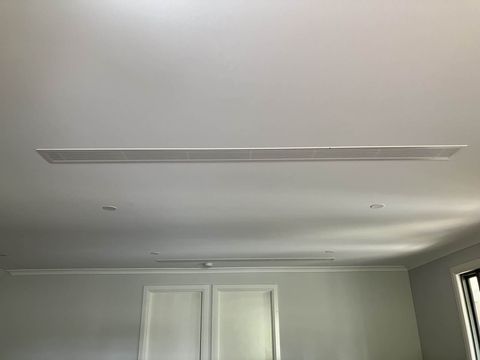
| What you see | Vents only | An indoor unit on the wall of each room |
| Room-by-room control | Zones; the ACT guide rates ducted zoning limited to good | The ACT guide rates multi-head zoning very good |
| Suits | Larger homes, above 180sqm in the ACT guide | Smaller homes, or where only a few rooms need heat |
Will splits really replace whole-house heating?
Sometimes, and it's a fair worry. In a 2021 JWS Research survey for the Victorian Government, the top reasons home owners gave for not heating with reverse cycle were that a larger house needs several splits (59%) and that a split's indoor unit can only push air so far, so it struggles in big rooms or past interior walls (56%).
If you're used to every room being warm, ducted reverse cycle is the closer match. If you mostly live in two or three rooms, splits or a multi-split can do the job with less work.
What makes the switch bigger or smaller
New ducts. Going ducted means new, larger ducting throughout, and the old ducts and heater coming out.
The switchboard. The ACT guide says a large house may need 3-phase power for ducted or multi-head units.
The gas connection. A licensed gasfitter needs to disconnect the old heater safely. If the cooktop and hot water stay on gas, the connection stays; going fully all-electric means planning those too.
Sizing for winter. In Melbourne, Canberra, Hobart or Ballarat, size the system for the coldest nights, not the summer peak.
Discounts and finance
In Victoria, some reverse cycle jobs can get a VEU discount through an accredited private provider. The program is voluntary, the system must both heat and cool, and from 30 September 2026 a ducted VEU job has a minimum co-payment of $3,000.
In the ACT, the Sustainable Household Scheme offers low-interest loans through Brighte for electric heating and cooling. Under the Home Energy Support Program for eligible concession card holders, use a supplier on the Brighte list and don't accept a quote until you're pre-approved. Our rebates by state guide has more.
Your prep, and the installer's job
You can
- List the rooms you heat, and the hours you heat them.
- Try our running cost tool with your own power rate.
- Decide whether hot water and cooking are staying on gas.
Leave to a licensed installer
- The heat load, sized for winter.
- Disconnecting the gas heater, which is gasfitting work.
- New ducts, refrigerant work and any electrical upgrade.
- Removing the old heater and ducts from the roof space.
Questions to ask before you sign
- Is the system sized for our coldest weather, from a heat load?
- Are the old gas ducts coming out, and what insulation will the new ducts have?
- Does the switchboard need work, or 3-phase power?
- Who disconnects the gas heater, and are they a licensed gasfitter?
- If there's a VEU discount, who is the accredited provider and what's my co-payment?
- If we agree to this at my kitchen table, when does my cooling-off period end?
What we'd do
If it were our home
If the gas heater still works and we owned the place in Victoria, we'd keep it serviced and start getting quotes for reverse cycle now, without the pressure of a dead heater in July. We'd ask for a heat load sized for winter, new insulated ducts if we were going ducted, and the switchboard checked up front. In Canberra we'd move sooner, given the gas phase-out. And we'd choose an installer who does gas-to-electric changeovers often, because they'll spot the switchboard and duct problems before they turn into surprises.