How does a heat pump heat a house?
The ACT Government's guide explains it well. A compressor, an expansion valve and two heat exchangers pull heat from the outside air and release it inside, instead of heating air directly the way an element heater does.
There's more heat in cold air than you'd think. The same guide says air at 0 degrees still holds over 90% of the heat energy of air at 40 degrees.
In Tasmania they're usually just called heat pumps. Elsewhere it's reverse cycle air conditioning, in the form of split systems, multi-heads, floor consoles and ducted systems. Solar Victoria also describes heat pump hydronic systems, which turn heat from the outside air into hot water piped to radiator panels or under the floor.
A heat pump against other heaters
| Reverse cycle heat pump | Electric element heater | Gas wall heater | |
|---|---|---|---|
| Efficiency in the ACT guide's heater comparison | 370% to 600% | 100% | 85% |
| Heat for the energy used | 3 to 6 units of heat per unit of electricity, the ACT Government says | One unit of heat per unit of electricity | Burns gas to make heat |
| Running cost, as government guides compare them | About a third of an electric heater's in the same space, Solar Victoria says | The comparison point | The ACT says gas heats quickly, but reverse cycle has much lower running costs |
| Carbon monoxide risk | None | None | Energy Safe Victoria says any gas heater can spill carbon monoxide |
| Summer | Cools as well | No | No |
Does it work when it's freezing outside?
Yes, within limits. The ACT guide says efficiency changes with the outdoor temperature, but good systems still work at -10 degrees in winter. As one model example, Mitsubishi Electric's MSZ-AS90VGD manual gives a heating operating range down to -15 degrees outside. Ranges are model specific, so check the one you're quoted.
The ACT guide also suggests asking whether a split has an H2 rating, which it says means the unit will heat efficiently in a Canberra winter. On the energy rating label, look for the red heating stars for your zone.
On cold, damp mornings, frost builds up on the outdoor unit. Mitsubishi Electric says the unit stops heating for up to 10 minutes to defrost, and the white cloud you might see is vapour from the defrost, not smoke. Water drips from the outdoor unit while it happens.
Thinking of moving off gas?
There's no rush if you own the home. The Victorian Government says existing homes don't have to swap gas space heating for electric.
Rentals are different, but narrower than people think. From 1 March 2027, when a Victorian rental's main living area heater permanently fails and can't be repaired, its replacement must be an energy efficient electric system. A working gas heater can stay. The gas or electric checker walks through it.
Some Victorian reverse cycle jobs can get a VEU discount through an accredited provider, because the program's air conditioner categories cover units that both heat and cool. Your installer will tell you if they're accredited and whether your job could qualify.
Mind the neighbours on winter nights
Heat pumps often run late on cold nights, and the outdoor unit makes noise. In Victoria, a heat pump on heating mustn't be heard in a neighbour's habitable room after 10pm, or before 7am on weekdays and 9am on weekends and public holidays.
EPA Tasmania's guideline sets 40 dB(A) between 10pm and 7am, measured a metre from the neighbour's wall nearest the unit. Our noise guide covers the other states.
Ask before you buy a heat pump for heating
- Was it sized for our coldest mornings, not just for summer?
- What heating capacity does the label show at 2 degrees?
- How many red heating stars does it have for our climate zone?
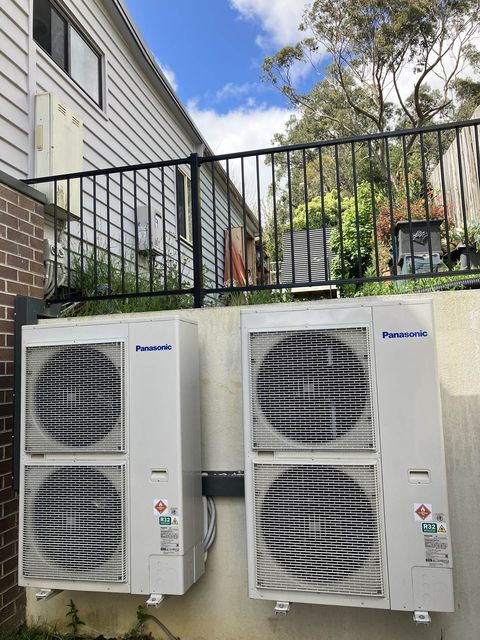
- Where will the outdoor unit sit, and where will the defrost water go?
- How far is the outdoor unit from the neighbours' bedrooms?
- In Victoria: are you, or a provider you work with, accredited for VEU?
Yours to do, and theirs
You can
- Set it between 18 and 20 degrees in winter, as the federal Energy Rating calculator suggests.
- Leave it alone while it defrosts. The pause is normal.
- Clean the filters as the manual says.
- Keep the outdoor unit clear, and don't stand on it or stack things on top.
Leave to a licensed installer
- Sizing it for your home's winter heat loss.
- Refrigerant pipework and the electrical connection.
- Disconnecting an old gas heater, which is a job for a licensed gasfitter.
- Fixing an outdoor unit that ices up and doesn't clear.
What we'd do
If it were our home
In a cold-climate home we'd size the heat pump for July, not January. Ask for the heating capacity at the low test temperature and a heat load done for winter, and put the outdoor unit where its noise and drips won't bother anyone. A heating specialist will ask about your coldest room before they talk brands, and that's the installer you want.