If you heat with gas now
Energy Safe Victoria says any gas heater can spill carbon monoxide, old or new, ducted or wall-mounted, and you can't smell it. If people at home get headaches, dizziness or nausea that ease when they go out, get everyone into fresh air, turn off the gas appliances, open the windows and doors, and call 000 in an emergency. Don't use the heater again until a qualified gasfitter has checked it. Energy Safe Victoria's standing advice is a service at least once every two years.
How each one makes heat
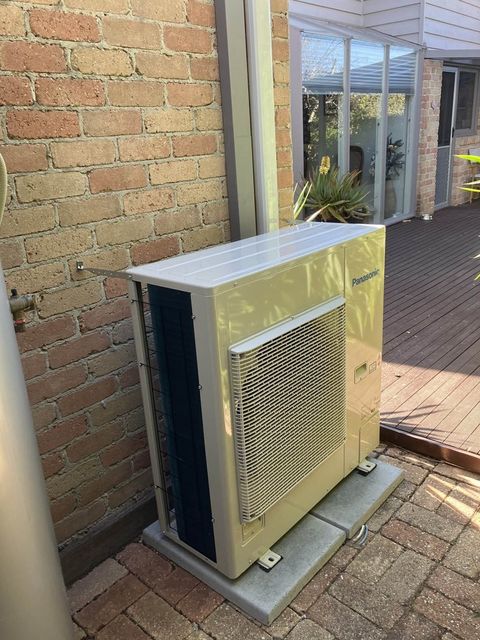
A reverse cycle system is a heat pump. The ACT Government's guide says it pulls heat energy out of the outside air and moves it indoors, rather than heating the air directly the way an element heater does. Cold air still holds plenty: the guide says air at 0 degrees has over 90% of the heat energy of air at 40 degrees.
A gas heater burns gas to make its heat. Seeley says a ducted gas heater draws air from inside the house, heats it and sends it back out through the outlets. A gas wall furnace does the same job for a single room.
That difference is why the efficiency figures look so lopsided. The ACT guide's heater comparison lists a gas wall heater at 85%, an electric element heater at 100%, and reverse cycle at 370% to 600%.
Reverse cycle and gas, side by side
| Reverse cycle | Gas heating | |
|---|---|---|
| How it heats | Moves heat from the outside air into the house | Burns gas to heat air, or water in a hydronic system |
| Efficiency | A CoP of 250% to 600%, the ACT guide says | Rated in stars: more stars, more efficient, Seeley says |
| Cooling | Heats and cools from the same unit | Heating only, unless you add a cooling system |
| Cold mornings | Good systems still work at minus 10 degrees, the ACT guide says | Heats a home quickly, the ACT Government says |
| Safety | No flame and no flue in the house | Can spill carbon monoxide, so servicing matters |
| Servicing | Every year, or as the maker recommends | At least every two years, by a licensed gasfitter |
| Victorian discounts | Some jobs can get a VEU discount through an accredited provider | Not covered: VEU air conditioner categories must heat and cool |
Which one uses less energy?
Reverse cycle, by a long way. Solar Victoria puts it at up to 6 units of heat for each unit of electricity, and the ACT Government at 3 to 6, against one unit of heat per unit of electricity for a portable electric heater.
If you searched for whether electric heating is cheaper than gas, the honest answer is that it depends on what you pay for each, how well the house holds heat and how you use the heater. Rates vary so much between households that we don't publish figures. You can work out the electric side with the method in our running costs guide: the unit's input power, times the hours, times your rate.
Will reverse cycle keep up in a cold winter?
It's the fair question in Melbourne, Canberra, Hobart and the tablelands. The ACT guide says a system's CoP varies with the outdoor temperature, but good systems still work at minus 10 degrees in winter.
It also suggests asking whether a split has an H2 rating, which it says means the unit will work efficiently in a Canberra winter. On the energy label, read the red heating stars for the cold zone, and get the unit sized for winter, not just summer. Our sizing guide shows how.
The rules in Victoria, in plain terms
If you own and live in your home, nothing makes you switch. DEECA says there's no requirement for existing homes to upgrade gas space heating to electric.
New gas is a different story. From 1 January 2027, plumbing work that connects mains gas to a house that doesn't already have it, or to one under construction, is banned. The Victorian Government says all new homes will be built all electric from that date.
Rentals have their own rule. From 1 March 2027, when the heater in the main living area permanently fails and can't be repaired, the replacement must be an energy efficient electric system. A working gas heater installed before then can stay. The Victorian rental rules guide and the gas or electric checker go into the detail.
On discounts, some reverse cycle jobs can get a VEU discount through an accredited private provider. The program is voluntary, your installer will tell you whether they offer it, and it never covers gas heaters. In NSW, the Energy Savings Scheme gives no incentive for gas space heaters installed from 1 July 2026.
In the ACT
The ACT has gone further. New gas network connections have been prevented in residential zones since 8 December 2023, the government's goal is to phase out fossil fuel gas by 2045, and it says parts of the gas network will likely be shut down from the mid-2030s. It recommends replacing old gas appliances with the most efficient electric systems when the time is right.
If you have gas ducted heating now
You've got three realistic paths. Keep the gas heater serviced and, if it's compatible, add cooling through the same ducts. Replace it with ducted reverse cycle, which means new ducts, because the ACT guide says gas ducts are too narrow to reuse. Or put reverse cycle splits in the rooms you use most and run the gas less.
Someone who specialises in switching from gas to electric will look at your switchboard, the ducts and the rooms you actually use before suggesting which path fits.
What's yours, and what needs a licence
You can
- Check the service record or sticker on your gas heater, and book a service if it's been more than two years.
- Fit a carbon monoxide alarm as a back-up. Energy Safe Victoria says it's never a substitute for servicing.
- Don't run the rangehood or bathroom fans while the gas heater's on. Energy Safe Victoria says that can pull carbon monoxide into living areas.
- Note which rooms you heat, and when, before you get quotes.
Leave to a licensed installer
- Servicing, testing or disconnecting a gas heater: a licensed gasfitter.
- Carbon monoxide testing of the heater.
- Installing reverse cycle: an ARC licence holder, plus your state's plumbing and electrical rules.
- Any switchboard or new circuit work: a licensed electrician.
What we'd do
Where we'd start
If your gas heater is working, recently serviced and not an unflued type, there's no rush and no rule forcing a change. We'd keep it serviced and plan for reverse cycle when it's due for replacement. If it's old, unflued or playing up, we'd have it checked for carbon monoxide straight away and ask a reverse cycle specialist to quote for the rooms you use most. The ACT Government recommends replacing any unflued gas heater immediately.