When does an air conditioner need a service?
Once a year is the usual answer. Mitsubishi Electric recommends a yearly professional service, and the ACT Government says the same: every year, or as often as the manufacturer recommends.
Timing matters as much as frequency. Daikin suggests a licensed technician looks over the unit at the start of every summer, so problems turn up before the first hot spell rather than during it. If your system works hardest in winter, as reverse cycle heating does in a cold climate, book it before the cold arrives instead.
Don't wait for the yearly visit if something has changed. A unit that's lost its punch, smells musty, drips inside or has started making a new noise usually needs a repair as well as a service.
Does skipping a service affect the warranty?
It can, so read your warranty card before you decide to skip a year. ActronAir's terms make the owner responsible for maintenance by a suitably licensed or qualified person once every 12 months in a home. Gree's card says its warranty is void if regular maintenance isn't done at intervals of no more than 12 months by a suitably qualified tradesperson.
Hitachi says its warranty doesn't apply if regular service hasn't been carried out by an ARC licensed installer, and Haier asks for records of all service and maintenance when you lodge a claim. Keep every service invoice in one place. Our warranties guide covers the rest of the fine print.
What a proper service includes
Filters and the indoor unit
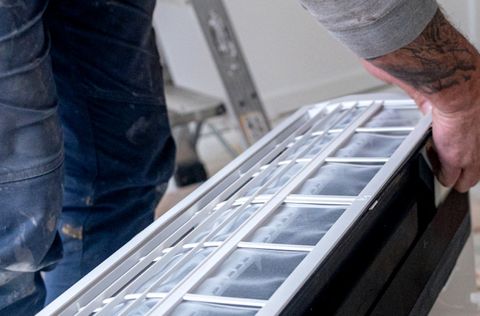
The filters come out and get cleaned, and the technician checks the coil and fan behind them. Mitsubishi Electric says that after several seasons an indoor unit needs inspection and maintenance that takes specialised knowledge and skills.
Coils, drains and connections
Daikin's summer tune-up list covers cleaning the coils, checking the refrigerant charge, tightening electrical connections, flushing the drains and inspecting any ductwork.
The outdoor unit
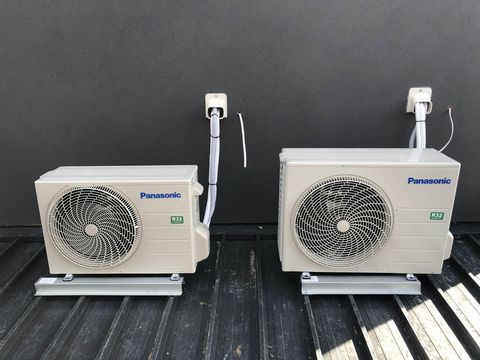
Leaves, grass clippings and cobwebs get cleared from around the casing. Daikin says debris around the outdoor unit can make it run less efficiently.
A test run
A reverse cycle system should be run in both cooling and heating before the job is called done.
A written note of what they found
Anything that needs fixing should be written down as a separate item, so you can decide about it in your own time rather than on the spot.
What makes a service bigger or smaller?
The number of indoor units is the biggest factor, because each wall unit, cassette or floor console is cleaned and checked on its own. A ducted system adds the return air filter, the zone controls and a look at the ducts.
Access comes next. MHIAA's warranty terms ask for units to be safely accessible with a 1.7 metre ladder, and LG's warranty excludes the extra costs of reaching units in restricted or unsafe locations. A head up high on a second storey, or an outdoor unit on a roof, takes more time and equipment.
Then there's how long it's been. A unit that has gone years without attention may need a full strip-down of the coil and fan, which is closer to a mould clean than a routine service. And if the technician finds the refrigerant low, the job becomes finding a leak. That's never a quick top-up, and our regas page explains why.
Near the sea, ask for the outdoor unit to be checked for corrosion. Daikin's warranty card, for one, puts extra corrosion protection in sea air on the owner, and our coastal homes guide goes into it.
Who's licensed to service it?
Checking or handling the refrigerant needs a full RAC01 licence from the Australian Refrigeration Council. The restricted RSS03 licence lets someone install a single-head split, but the ARC says it doesn't cover any service, repair or maintenance that involves accessing the refrigerant.
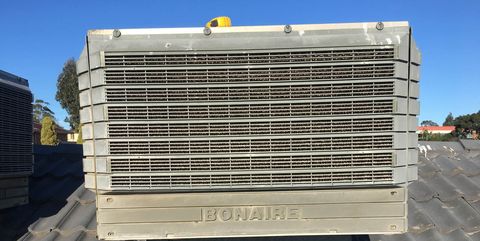
So ask for an RAC01 technician, ideally one who services your kind of system every week: a split specialist for wall units, a ducted specialist for a ducted system. Gas heaters and evaporative coolers are separate trades, with their own pages on gas heater servicing and evaporative cooler servicing.
Your part, and the technician's
You can
- Clean the filters on your manual's schedule. Daikin, Mitsubishi Electric and Samsung all say about every two weeks, and Samsung says more often if you have pets.
- Turn the unit off at the power before you take the filters out, and let them dry in the shade before they go back in.
- Keep the outdoor unit clear of leaves, plants and anything stored against it.
- Make a note of smells, drips, noises or rooms that never get comfortable, and tell the technician.
Leave to a licensed installer
- Opening the indoor unit to clean the coil, fan and drain tray.
- Checking the refrigerant charge and looking for leaks.
- Tightening electrical connections and testing the controls.
- Any unit on a roof or above a comfortable ladder height.
What to look for on the booking and the invoice
- A written list of what the service covers, for each indoor unit and the outdoor unit.
- Whether the refrigerant charge will be checked, and that the technician holds an RAC01 licence.
- The business's RTA number, which starts with AU, on the quote and the invoice. The ARC requires it.
- Any repairs found, listed separately with what's wrong, rather than done without your say-so.
What we'd do
Our take
Book a service once a year, timed before the season you rely on most, and make sure the person coming holds an RAC01 licence so the refrigerant can be checked properly. Clean the filters yourself in between. If the technician finds a fault, get it in writing and decide later: a good service visit shouldn't turn into a sales pitch.