Leaks, tripping breakers and refrigerant
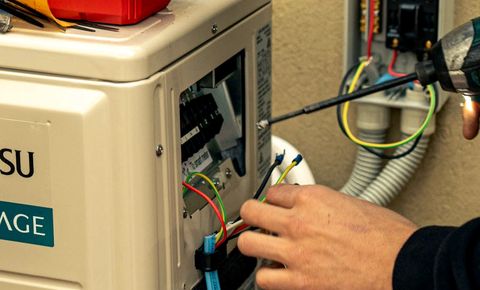
Mitsubishi Electric says a unit that won't cool or heat could be leaking refrigerant, and that if a leak is found you should stop the system, air the room thoroughly and get it seen to immediately. It also says to stop using the unit when the breaker trips often. Never try to top up refrigerant yourself: without an ARC licence it's an offence, and topping up before a leak is fixed is illegal for anyone.
Checks you can do in ten minutes
Check the mode and the set temperature
It should be on Cool or Heat, not Fan or Dry, with the set temperature below the room temperature for cooling or above it for heating. Mitsubishi Electric also suggests turning the fan up to High or Super High.
Look at the timer and sleep settings
Samsung says to make sure Timed Off or Sleep isn't enabled. Either can make a unit wind down or stop by itself.
Clean the filters
Daikin says blocked filters can reduce a system's efficiency significantly, and calls cleaning them the most important maintenance task an owner can do. Our filter cleaning guide shows how, with the power off.
Clear the way for the air
Mitsubishi Electric's checklist asks whether anything is blocking the inlet or outlet of the indoor or outdoor unit. Westinghouse adds curtains, blinds and furniture in front of a unit to the list. Outside, pull back plants, bins and anything stacked against the casing.
Close up the room
An open window or door is on Mitsubishi Electric's list of reasons a room won't cool or heat enough. A gas cooktop or an exhaust fan running in the same space adds to the load too.
Give it time
Mitsubishi Electric says a unit can take a while to reach the set temperature, depending on the size of the room and the weather outside. After being switched off, its units also wait about 3 minutes before they'll start again.
Is it the weather or the system?
On a scorcher, even a healthy system can fall behind. ActronAir says an air conditioner loses cooling capacity above 35 degrees, with the example of a 14 kW system dropping to a 10 kW or 12 kW capacity. Mitsubishi Electric makes the same point about heating on very cold days.
If it copes most of the time and only struggles on the hottest afternoons, the unit may simply be too small for the space. Rinnai says an undersized system often leads to insufficient cooling or heating. Our size calculator is a quick way to sanity-check it.
Check what you're asking of it, too. The Australian Government's Energy Rating calculator suggests 25 to 27 degrees in summer and 18 to 20 degrees in winter, and says each extra degree of heating or cooling could add 10% to your electricity bill.
Not heating? Some of this is normal
Reverse cycle heating does a few things that look like faults. Mitsubishi Electric says air doesn't blow straight away when heating starts, because the unit is warming up first. In cold, damp weather the outdoor unit can also stop for about 10 minutes while it defrosts, and any white vapour you see drifting off it then comes from the defrost.
Got a multi-split, with several indoor units on one outdoor unit? Check what the other rooms are set to. Mitsubishi Electric says all the indoor units on one outdoor unit must share a mode, heating or cooling, so one bedroom left on cool can stop the lounge from heating. It also doesn't recommend Auto mode on its multi systems.
When it's time for a technician
If the checks haven't fixed it, the likely culprits are a refrigerant leak, a failed fan or sensor, a fault in the outdoor unit, or ice building up on the coil. Westinghouse's advice for its window and wall units is that ice blocks the airflow and stops the unit cooling, so run the fan on medium or high until it melts, and if the problem returns, disconnect the power and book a service.
A refrigerant problem needs a technician with a full RAC01 licence, and the leak has to be found and repaired before any refrigerant goes back in. Our regas page explains why a top-up on its own isn't legal.
For anything else, an air conditioning repair specialist who works on your brand will usually find the fault faster than a generalist, and will know what its error codes mean.
What's safe for you, and what's for a technician
You can
- Changing the mode, set temperature, fan speed and timer settings.
- Cleaning the filters as the manual says, with the power off first.
- Clearing space around the indoor and outdoor units.
- Resetting a tripped breaker once, and leaving it off if it trips again.
- Noting when it struggles: all day, only on hot afternoons, or only in heating.
Leave to a licensed installer
- Checking refrigerant pressures and repairing leaks.
- Testing fans, sensors and circuit boards.
- Working out why ice keeps forming on the coil.
- Any electrical fault, including a breaker that keeps tripping.
What we'd do
If it were our home
We'd go through the mode, the filters and the outdoor unit before anything else, because they solve a lot of 'broken' systems. If it still won't cool or heat on a mild day, we'd switch it off and book a repair specialist for that brand. And we'd say no to anyone offering to top it up with gas without finding the leak first.