How does ducted air conditioning work?
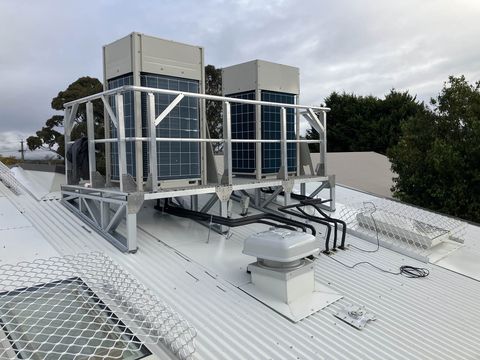
The ACT Government's guide describes the layout simply: one large compressor outside, one heat exchanger unit inside, usually in the ceiling or under the house, and insulated ducts branching off to the rooms. Air comes back through a return air grille, gets heated or cooled, and goes out again.
Mitsubishi Electric calls it whole-house temperature control where only the vents are visible.
Ducted reverse cycle isn't the same as gas ducted heating, which only heats. If you already have gas ducted and want summer cooling, add-on cooling is a separate system that can work through the existing ducts.
Ducted or a set of splits?
| Ducted reverse cycle | Several split systems | |
|---|---|---|
| Coverage | The whole house from one installation | One room or open area per unit |
| Efficiency in the ACT guide (CoP) | 3.5 average, 5.0 excellent, with some heat lost through the ducts | 3.7 average, 6.4 excellent, with no ducts |
| Even temperature | Easier to keep the whole house even | Each room is its own |
| Cooling the whole house | The ACT Government says it generally costs more to run than a split | You only run the rooms you're in |
| What you see | Vents, a return grille and a controller | An indoor unit on each wall, and an outdoor unit for each |
What makes one ducted quote bigger than another
A ducted quote depends on the house far more than the box. These are the things that move it:
The size of the system. Mitsubishi Electric says a professional heat load calculation is essential, taking in climate, orientation, insulation, windows and ceiling height.
Outlets, zones and access. Every extra vent, zone and damper adds parts and time, and low roof pitches, two storeys and tight access make the duct runs harder.
Old ducts. The ACT guide says ducts from a gas ducted heater can't be reused for reverse cycle, because they're too narrow and may have age-related problems.
Duct insulation. The same guide recommends at least R1.5 on the ducting to cut heat loss, and warns that suppliers may not include it unless you ask.
Power. In a large house, the ACT guide says the system may need a three-phase supply. The installer can confirm.
Two quotes that look miles apart are often for different jobs, so compare them line by line with our quote guide.
Zoning: running only the rooms in use
Zoning splits the house into areas you can run separately. ActronAir says it works through dampers in the ductwork that open or close to each zone, and Daikin's example puts the bedrooms in one zone and the living areas in another.
It has limits. ActronAir says its systems can only hold a 4-degree difference between zones and can only heat or cool at any one time, and that zoning without the right temperature sensors can be less efficient. More on zoning and controllers.
Before anyone goes into the roof
Leave the roof space to the installer. WorkSafe Victoria has reported workers seriously hurt falling through plaster ceilings, and tells them not to step on the ceiling material. In Canberra, Mr Fluffy loose-fill asbestos was found in some heating and cooling ducts and vents, and affected homes carry a safety tag at the meter box and switchboard. If you see one, tell the installer before anyone climbs up.
Ask these before you sign a ducted quote
- Can I see the heat load you sized this from?
- How many outlets and zones, and where does the return air grille go?
- What R-value is the duct insulation?
- Are any existing ducts being reused, and are they suited to this system?
- Which ARC licence does each technician on the job hold? The restricted splits licence only covers single-head systems under 18 kW, so larger ducted systems need RAC01.
Signed on the night? You may have time to think
Asking for a quote doesn't make the installer's visit an invited sales visit. A ducted system agreed at the kitchen table can be an unsolicited consumer agreement with a 10 business day cooling-off, and the installer can't take payment or supply the work in that time. Our cooling-off guide explains it.
In Victoria, a ducted job under the VEU program carries a minimum co-payment, which went up on 30 September 2026, so be wary of anyone offering ducted at no cost to you.
Yours, and theirs
You can
- Clean the return air filter as your manual describes.
- Keep vents and the return grille clear of furniture and curtains.
- Use the zones to run only the rooms you're in.
- Keep leaves and clutter away from the outdoor unit.
Leave to a licensed installer
- Sizing the system and designing the duct runs.
- All work in the roof space or under the floor.
- Refrigerant work and the electrical connection.
- Duct repairs, insulation and adding zones.
What we'd do
If it were our home
We'd get a ducted specialist up in the roof before talking brands, and ask for the heat load, the duct insulation rating and the zone layout in writing. Then we'd take the quote away and read it properly. A good installer won't mind you sleeping on it.