How does a split system work?
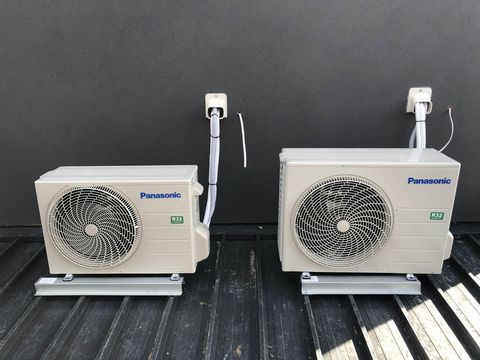
The outdoor unit holds the compressor. Refrigerant travels through the pipes between the two units, picking up heat on one side and letting it go on the other. In cooling, heat comes out of your room and is dumped outside. In heating, the process runs backwards.
The ACT Government's guide to reverse cycle systems puts the heating side well: the unit extracts heat from the outside air and moves it indoors, rather than heating air directly the way an element heater does. Our heat pumps page covers the winter side.
Nearly every split sold now is an inverter model, which slows the compressor as the room nears the set temperature. ActronAir calls inverters the industry standard across every brand.
Each unit is sold by capacity in kilowatts, such as 3.5 kW. Solar Victoria says the supplier should assess the room and recommend the size, and our sizes pages cover what each common size suits.
Which rooms and homes suit a split?
A small split looks after a bedroom or a study. The ACT guide says larger splits can cover areas of up to 80 square metres, which takes in most apartments and the living area of a smaller house.
For the whole home, the same guide points splits at houses under 180 square metres, or homes that only need some rooms done. Above that, ducted or a multi-head usually fits better.
In a 2021 survey for the Victorian Government, the top two reasons home owners gave for not choosing reverse cycle heating were about splits: a larger house needs several of them (59%), and an indoor unit can only push air so far, so big rooms and spaces broken up by walls are hard work (56%).
Wall-hung, floor or ceiling: the indoor unit styles
| Wall-hung | Floor console | Ceiling cassette | |
|---|---|---|---|
| Where it goes | High on an inside wall | Low on the wall, or on the floor | Recessed into the ceiling |
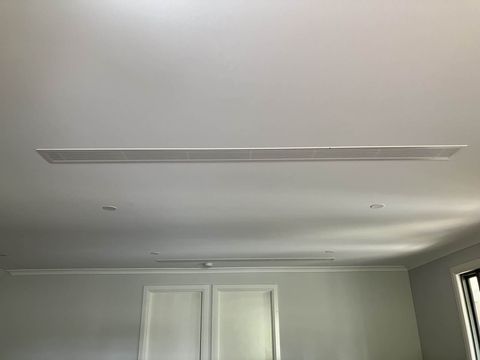
| Suits | Bedrooms and living rooms with a clear wall up high | Rooms short on high wall space, and rooms where heating matters most | Rooms short on wall or floor space, and big open areas |
| Worth knowing | The outdoor unit usually sits close behind it | Mitsubishi Electric says consoles work well in heating | Needs depth in the ceiling space above |
| Read more | Split system installation | Floor-standing units | Ceiling cassettes |
How efficient is a split?
The ACT guide rates efficiency as a coefficient of performance (CoP): the heat moved for each unit of electricity used. It gives splits 3.7 for an average system and 6.4 for an excellent one, a higher top figure than it gives multi-head or ducted systems.
There's no ductwork to lose heat through, and a house with a few splits is zoned simply by switching on the ones you need. When you compare models, read the energy rating label for your climate zone.
What to ask before you pick a model
- What size do I need in kW, and how did you work it out from this room?
- Does it heat as well as cool? Hitachi, for one, lists a cooling-only model in its wall split range.
- How many heating stars does it have for our climate zone?
- Where will the outdoor unit sit, and how close is that to a neighbour's bedroom?
- Who's doing the electrical connection, and will it have its own circuit?
What you can do, and what needs a licence
You can
- Measure the room and note which way its windows face.
- Compare star ratings for your zone across models of the same size.
- Clean the filters as the manual says, and keep leaves off the outdoor unit.
- Switch it off at the breaker if it trips repeatedly or smells of burning, as Mitsubishi Electric's instructions say.
Leave to a licensed installer
- Working out the size from a heat load.
- Fitting both units and running the refrigerant pipes. For a single-head split under 18 kW, that's an RSS03 or full RAC01 licence holder.
- Any later regas or refrigerant repair, which needs RAC01.
- The power supply, which Mitsubishi Electric says should be dedicated to the unit.
What we'd do
Our take
If you live mostly in one or two rooms, we'd put a properly sized split in each and leave the rest of the house alone. Once you're counting four or five splits to cover the place, stop and get a multi-head or ducted quote as well. Either way, have a split specialist size each unit from the room itself and show you the heating stars for your zone before you choose.