Choosing a split, step by step
Size it to the room
Measure the floor area and ceiling height, then use our sizing guide or the size calculator for a starting range. Rinnai's buyers guide, for example, puts rooms of 20 to 40 square metres at 3.5 kW.
Find your climate zone
The zoned energy rating label rates each unit for three climate zones. On the map in the ACT Government's example, Brisbane and Darwin are hot, Adelaide, Perth and Sydney average, and Canberra, Hobart and Melbourne cold. Read the stars for your zone.
Check heating as well as cooling
Mitsubishi Electric explains that red stars are for heating and blue stars for cooling. In a cold zone, the red stars deserve at least as much attention as the blue.
Compare like with like
The ACT guide says the meaningful comparison is between systems of a similar size in kW, rated for where they'll be installed. Mitsubishi Electric warns that stars on the old label and the newer zoned label shouldn't be compared.
Look at the yearly energy figure and the noise
Mitsubishi Electric says the label shows how much energy the unit uses each year for cooling or heating, and the lower that figure, the less it costs to run. The label also lists sound power for the indoor and outdoor units, where a lower number means quieter.
Read the warranty conditions
Before you sign, find out what keeps the warranty valid: who has to install it, how often it must be serviced, and whether you need to register it.
What the stars do and don't tell you
Rinnai says the label runs from 1 to 10 stars, based on independent testing, and Energy Made Easy says zoned labels have been required on air conditioners since 1 April 2020.
Stars aren't the whole story. A high-star unit that's the wrong size still won't feel right, and what a unit uses depends on how you run it. Our running costs guide shows how to work out your own from the input power and your power rate.
If you'd like a floor to measure against, Victoria's rental standard is a handy reference. From 1 March 2027, a non-ducted unit counts as energy efficient heating at 2 stars or more for heating, and as efficient cooling at 3 stars or more for cooling. Owner-occupiers aren't bound by it, but a unit below those marks sits behind where rentals are heading.
Inverter is the baseline now
An inverter unit keeps adjusting its output to the temperature in the room, which Daikin likens to a car's accelerator. Older fixed-speed units, ActronAir says, simply switch the motor on or off.
Rinnai says all of its current split ranges use inverter technology, and CHOICE says that's part of why real running costs can be lower than the rated figures. So inverter is what you should expect on any new split, rather than a reason to pick one over another. Our page on inverter air conditioners explains more.
Where it goes, and who'll hear it
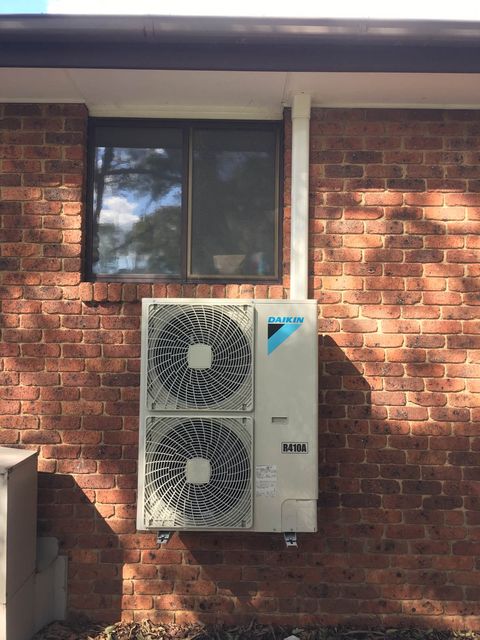
The outdoor unit needs fresh air, room to be serviced and a spot where its noise won't bother anyone. In Victoria, a unit cooling at night mustn't be heard inside a neighbour's habitable room after 11pm, and on heating the cut-off is 10pm. Our guide to noise rules and neighbours has the detail.
Near the coast, read the corrosion clauses. Daikin, Mitsubishi Heavy Industries and Carrier's warranty documents each make the owner responsible for extra corrosion protection in sea air. Our coastal homes guide explains what that means in practice.
What to check in the warranty
- Who must install it. Mitsubishi Electric's card says the warranty won't apply if the unit isn't installed by a licensed installer or is installed incorrectly.
- How often it must be serviced. Gree's card voids the warranty if regular maintenance isn't done at intervals of no more than 12 months by a suitably qualified trades person.
- Whether you have to register it, and by when. ActronAir asks owners to register within 14 days.
- When the clock starts. ActronAir's period starts at commissioning, while Daikin's runs from the date the original owner bought the unit.
- What happens if it moves. Daikin, Mitsubishi Electric and Gree all exclude units re-installed somewhere other than the original location.
- Coastal conditions, if you live near the sea. Our warranties guide covers the rest.
What's yours to decide, and what's the installer's
You can
- Which rooms need a unit, and how big each room is.
- Your climate zone on the label map, and the heating stars for it.
- The noise figures, if the unit's going in a bedroom.
- Registering the warranty once it's in, if the brand asks you to.
Leave to a licensed installer
- Confirming the size with a heat load.
- Checking the power supply: Mitsubishi Electric says the unit needs a dedicated one.
- Refrigerant pipework and commissioning, which need an ARC licence.
- Recommending corrosion protection if you're near the sea.
Warning signs on a split system quote
- A size picked without anyone looking at the room.
- No brand and model number, just a description like 'a 7 kW split'.
- No Refrigerant Trading Authorisation number. The ARC requires it on quotes.
- An outdoor unit squeezed into an enclosed courtyard or boxed in with slat fencing, both of which the ACT guide says to avoid.
- Pressure to sign on the spot. A deal done at your kitchen table can be an unsolicited agreement with a 10 business day cooling-off.
What we'd do
Our take
Settle the size first, then shortlist two or three models of that size with good heating stars for your zone and noise figures you can live with. After that, let the installer and the warranty terms decide it. A split specialist who fits that brand regularly will know its coastal options and its warranty conditions, and that matters more than half a star on the label.