How close to the sea counts as coastal?
There's no single line, and none of the brand material we read gives one. Daikin's coastal FAQ gives no distance-from-the-sea rule, and neither do Midea's, TECO's or TCL's pages.
The nearest thing to a yardstick comes from corrosion standards for steel. The Galvanizers Association of Australia's guide to AS 4312 rates the zone within 200 m of rough seas and surf beaches as C5 (surf sea-shore). It rates 200 m to 1 km inland from surf as C4, and 1 km to 10 km inland along ocean fronts with breaking surf and significant salt spray as C3.
Around calm, sheltered bays the bands are tighter. The same guide rates the shoreline to 50 m inland as C4 and 50 m to 1 km inland as C3, and notes that prevailing winds can push the bands further inland.
Those categories describe how hard the air is on metal generally, not on air conditioners in particular. Still, if you're within a kilometre or so of the water, or downwind of breaking surf, we'd treat the house as coastal.
What do warranties say about salt air?
Read the corrosion clause before you settle on a brand. The wording tends to fall into two groups.
Some make the extra protection the owner's job. Daikin's card makes the owner responsible for additional corrosion protection where the product is installed in a corrosive environment such as sea air. Mitsubishi Heavy Industries says much the same, and so does AHIC in its Carrier and Toshiba warranty.
ActronAir spells out what that protection means. Its terms say the purchaser must apply additional corrosion protection in sea air, described as regularly washing down the outdoor unit, panels and coils with a mild detergent.
Others simply exclude the damage. Mitsubishi Electric's card doesn't cover damage to paintwork, metalwork or trims from salt, and Samsung's excludes salt spray, sand and dust. Rinnai, Haier, TCL and Brivis each exclude salt or corrosion damage in their own words.
We're not any brand's dealer, and this isn't a ranking. It's a reason to read the card for the exact model you're quoted, because that clause decides a claim.
What is Blue Fin, and do coil coatings help?
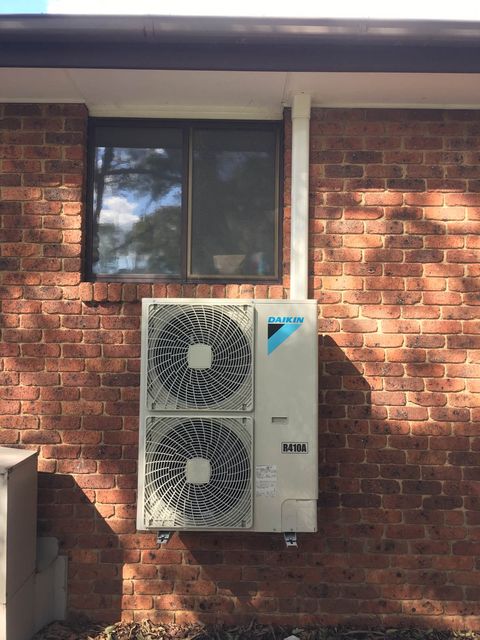
Blue Fin is Daikin's name for the anti-corrosion treatment on its outdoor unit coils. Daikin says all its outdoor coils have it, for greater resistance to salt damage from sea spray and rain, and that proper maintenance and positioning still matter.
Other brands describe their own coatings. TECO calls its version Gold Fin Protection, Midea talks about Prime Guard technology with Hyper Grapfins, and Carrier says its outdoor units have an anti-corrosive coating. LG lists an Anti Corrosion Gold Fin coating on one of its window wall units.
A coating is worth asking about near the water, but it doesn't replace care. Daikin treats every outdoor coil with Blue Fin, and its warranty card still puts extra corrosion protection in sea air on the owner.
Where should the outdoor unit go?
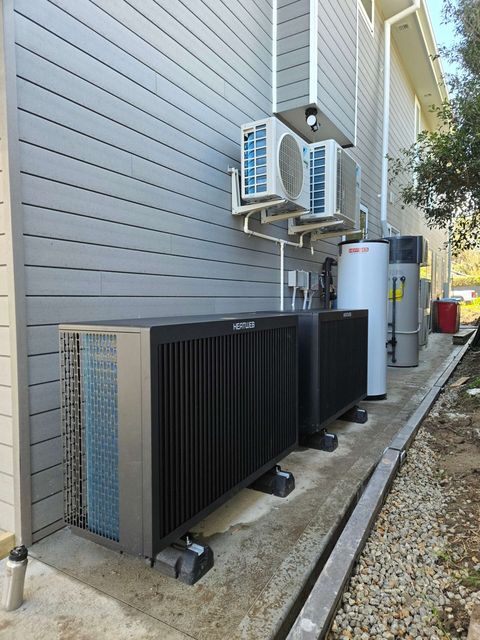
Placement is the part you control. Mitsubishi Electric's operating instructions name salty places such as the seaside among the places to avoid installing. On a coastal block, that usually means asking for the most sheltered wall that still has good airflow, out of the direct sea breeze.
Sheltered doesn't mean boxed in. The ACT Government's guide says the outdoor unit needs fresh air and easy access for maintenance, and warns against enclosed courtyards and slat fencing around it.
Then think about the fixings. The NT Government warns that corrosive air near the coast attacks bolts and fixing plates, and suggests a yearly visual check of brackets and bolts for rust or looseness. The Queensland Reconstruction Authority says homes close to the ocean need more frequent inspection and maintenance than those further inland. Our page on brackets and covers goes into mounting options.
Before you wash down an outdoor unit
Switch the system off at its isolator or the switchboard first, and check the manual for how the brand wants it cleaned. Only rinse what you can reach from the ground. Mitsubishi Electric warns against stepping on the outdoor unit or standing on anything unstable to reach it. Never climb onto a roof to get to a unit, and leave anything behind a panel to a technician.
Evaporative coolers near the sea
Seeley, which makes Breezair evaporative coolers, says reverse cycle systems offer more flexibility across humid, coastal and mixed-weather regions, and that evaporative cooling performs best in hot, dry climates. Our evaporative or refrigerated guide compares the two.
If you do want an evaporative cooler on a coastal roof, Seeley says Breezair developed the first corrosion-free, all-plastic rooftop cooler, and covers its Permatuf cabinets against corrosion for 25 years. Read exactly what that covers, because cover for the cabinet and Seeley's 7 year warranty on the cooler as a whole aren't the same thing.
Questions for a coastal installer
- Does this model have a coil coating, and what does its warranty say about salt?
- What does the brand's installation manual say about coastal placement?
- Where's the most sheltered spot that still gets fresh air and can be reached for servicing?
- What are the bracket, bolts and fixings made of, and how should I check them?
- How should I wash the outdoor unit down, and how often for my spot?
- Can the wash-down be part of each service?
Coastal care: yours and theirs
You can
- Keep sand, leaves and anything stacked against it away from the outdoor unit.
- Rinse it down as the manual or warranty asks, after switching it off.
- Look at the brackets and bolts from the ground once a year for rust or movement.
- Note the date each time you wash it. If you ever claim, it shows you did your part.
Leave to a licensed installer
- Choosing a position and fixings that suit sea air.
- Cleaning the coil and fins properly during a service.
- Treating or replacing corroded brackets and bolts.
- Anything on the roof or behind a panel.
What we'd do
Our advice near the water
Read the corrosion clause on the warranty card for the exact model you're quoted, before you sign. Ask for the outdoor unit on the most sheltered side that still breathes, and ask the installer to follow the brand's coastal installation guidance. Then wash it down on the schedule the card or manual sets, and keep a note of the dates. An installer who works near the beach every week will have done all of this many times.