Ground, pad or wall bracket: where should the outdoor unit sit?
The ground is the default. Appliances Online's standard install assumes the outdoor unit sits on a concreted path, and lists a wall bracket and concrete pads as items to be quoted. The Good Guys' standard install leaves out custom brackets.
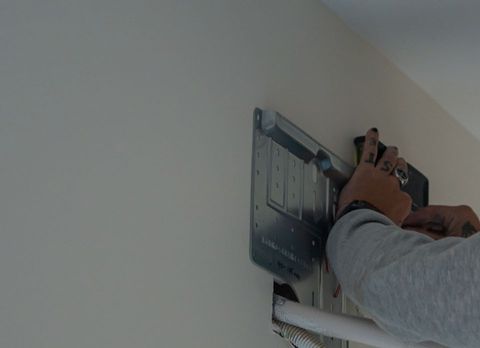
A bracket makes sense when there's no ground space, the ground gets waterlogged, or the unit would block a side path.
Whatever the mount, the unit needs air and access. The ACT Government's guide says to avoid enclosed courtyards and never to fence the unit in with slats, and that applies to decorative screens too. Mitsubishi Heavy Industries' warranty terms say the equipment must be reachable safely with a 1.7 metre ladder, so a bracket high on a two-storey wall makes every future service harder.
What are pipe covers for?
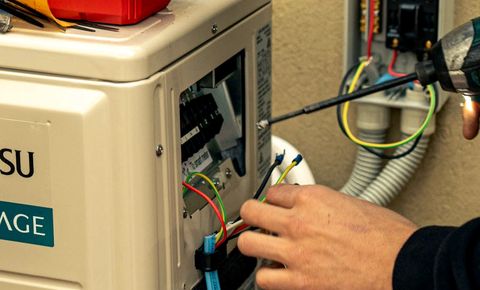
The refrigerant pipes, the power cable and the drain leave the house through one hole and run along the outside wall. A pipe cover, also called capping or ducting, is the plastic channel that hides them, keeps sun off the pipe insulation and stops them getting knocked.
Retail standard installs limit how much is included. The Good Guys allows up to 2.4 m of capping, while Bunnings includes up to 3 m of PVC ducting on a single-storey home and 5 m on a double-storey one.
When does an air conditioner need a condensate pump?
In cooling, the indoor unit pulls moisture out of the air, and the condensate drain (a small hose) carries the water away. Most drains simply fall from the indoor unit to the outside.
When the indoor unit sits on an inside wall, below the level outside, or far from anywhere water can go, gravity can't do the job, so a condensate pump lifts the water instead.
A pump is a moving part, and when one fails the water comes out of the indoor unit. Samsung lists a clogged drain, and a drain hose that's bent, pointing upward or sitting in water, among the causes of indoor leaks.
Near the coast
Salt air is hard on metal. Daikin's warranty card makes the owner responsible for extra corrosion protection in sea air, and ActronAir describes that protection as regular washing down of the outdoor unit, panels and coils with a mild detergent. Ask what the bracket and its fixings are made of, and read our coastal homes guide.
Your side of it, and theirs
You can
- Say where you'd be happy to see the outdoor unit and the pipe cover before the quote.
- Keep pots, plants and mulch clear of the outdoor unit. Daikin says leaves and debris make it run less efficiently.
- Check the drain hose outside points down and its end isn't sitting in water.
- Never stand on the outdoor unit or rest things on it. Mitsubishi Electric says not to.
Leave to a licensed installer
- Choosing a bracket that suits the unit's weight and the wall, and fixing it securely.
- Fitting the pipe cover and sealing the wall hole against rain.
- Setting the drain's fall, or fitting and wiring a condensate pump.
- Replacing a pump that has failed.
What we'd do
Our take
If there's ground space with good air around it, we'd put the outdoor unit there and skip the bracket. If there isn't, we'd want the bracket, the length of pipe cover and any pump named on the quote, and since pumps make a little noise, we'd ask where one will sit before agreeing to it in a bedroom. A split specialist will look for a way to give the drain a natural fall before reaching for a pump.