What that sound usually means
| Usually | What to do | |
|---|---|---|
| Cracking or creaking | Mitsubishi Electric says it's the front panel and other parts expanding or contracting as the temperature changes. | Nothing. It's normal. |
| Gurgling or burbling | Air drawn in through the drain hose, which Mitsubishi Electric says happens when a rangehood or exhaust fan is on, or in strong wind. | Nothing, unless water is dripping inside too. |
| A soft hiss | Mitsubishi Electric says the refrigerant can hiss when its flow inside the unit changes. | Normal on its own. Book a check if cooling or heating drops off as well. |
| Running water | Refrigerant or condensed water flowing through the unit. | Normal. |
| A click or clunk at start or stop | The fan or compressor switching on or off. | Normal. |
| Whistling | Samsung says dust on the fan can cause it. | Clean the filters. If it carries on, book a clean. |
| Rattling | Samsung says it often means loose panels. | Check nothing is touching the outdoor unit, then book a technician. |
| Grinding, screeching or banging | Something mechanical or electrical has gone wrong. | Switch it off and book a repair. |
Noise with smoke, a burning smell or a tripping breaker
Switch the unit off and turn off its breaker. Mitsubishi Electric says to stop the unit and cut the power when there's a burning smell, and not to keep using it when the breaker trips frequently. Don't take covers off, and don't stand on the outdoor unit to look: Mitsubishi Electric says not to step on it or put anything on top of it.
Why does my air conditioner keep turning off?
Some stops are built in. Mitsubishi Electric says its units can't be operated for about 3 minutes after a restart, to protect themselves. In heating, the outdoor unit can stop for up to 10 minutes to clear frost, and Mitsubishi Electric says the white 'smoke' you might see then is just vapour from the defrost.
Some are settings. Samsung says to check that Timed Off or Sleep isn't switched on.
Some come down to the compressor. ActronAir says fixed speed units work by switching the motor on and off, while an inverter compressor varies its speed to match demand. An older fixed speed unit cycling on and off is doing what it was built to do.
Frequent short bursts on a modern inverter are worth a closer look. Rinnai says an oversized system can cause short cycling (frequent on-off cycles), weaker dehumidification and accelerated wear and tear. And a unit that cuts out by tripping the breaker has a fault: switch it off and book a repair.
Quick checks for a noisy unit
Work out where and when
Indoor or outdoor? Cooling or heating? At start-up, all the time, or only as it stops? Samsung says some airflow and fan noise is normal, especially at start-up.
Clean the filters
Dust is behind a lot of whistling. Switch off at the power and clean them the way your manual describes.
Clear around the outdoor unit
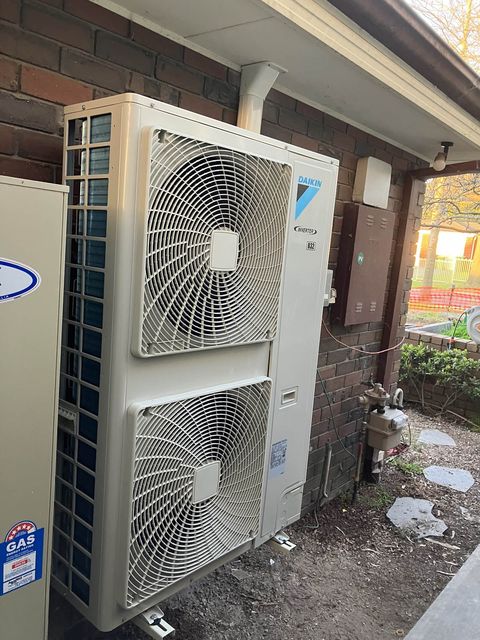
Move pots, bins and branches, and anything leaning against the casing or its bracket.
Check the exhaust fans
If the gurgle only happens while the rangehood or bathroom fan is running, it's the drain hose drawing air, and it's harmless.
Switch it off if it sounds wrong
Grinding, banging or screeching means stop. Running a unit with a failing part can turn a small repair into a big one.
Is it too loud for the neighbours?
Noise rules vary by state. In Victoria, EPA Victoria says an air conditioner used for cooling mustn't be heard inside a neighbour's habitable room after 11pm, or before 7am on weekdays and 9am on weekends and public holidays. For heating, the night cut-off is 10pm. During a heat health warning, you can run it at any time.
If you're buying, the energy label helps. Mitsubishi Electric says the noise figures on it are the sound power levels of the indoor and outdoor units, and lower numbers mean quieter running. Our noise and neighbours guide covers the other states.
Yours to check, and the technician's to fix
You can
- Cleaning the filters and clearing the outdoor unit.
- Noting when and where the noise happens, and in which mode.
- Checking the timer and sleep settings if it keeps switching off.
- Switching off at the isolator if it grinds, bangs or smells hot.
Leave to a licensed installer
- Tightening or replacing loose panels, mounts and brackets.
- Fan motors, bearings and fan blades.
- Compressor and electrical faults.
- Re-mounting an outdoor unit that vibrates against the wall.
What we'd do
What we'd do
If the sound is on the normal list, we'd leave it alone. If it's new and harsh, or the unit keeps tripping the power, we'd switch it off and book a repair specialist for that brand, with a note of the mode, the time of day and where the noise comes from. That note can save the technician a lot of hunting.