When does a multi-split make sense?
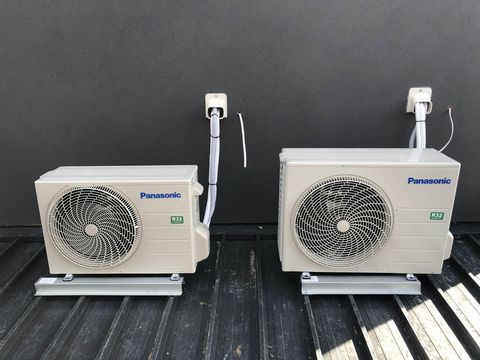
The ACT Government's guide calls multi-head systems a hybrid of split and ducted. Pipes run through the ceiling to each room instead of ducts, and they can serve several rooms almost as well as a ducted system.
They fit a few situations well: a home where ducting won't fit, an apartment with space outside for only one outdoor unit, or a few bedrooms plus a living area you want controlled room by room. The same guide says a small multi-head system can also serve one very large room that needs more than one indoor unit.
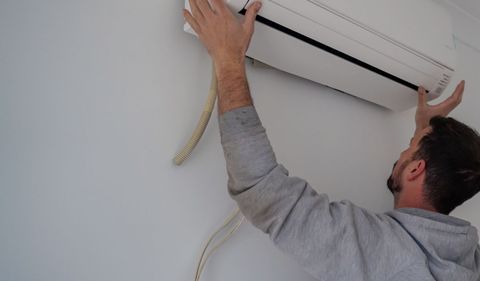
The indoor units don't have to match. The ACT guide lists wall hung, floor mounted and cassette styles, so a bedroom can have a wall unit while the lounge gets a floor console.
Multi-split, separate splits or ducted?
| Multi-split | Separate splits | Ducted | |
|---|---|---|---|
| Outdoor units | One | One for every indoor unit | One |
| If the outdoor unit stops | Every room on it stops | Only that room is affected | The whole system stops |
| Heating one room, cooling another | No, every indoor unit shares one mode | Yes, each split runs on its own | No, one mode at a time |
| Room by room control | Each room sets its own temperature | Each room is completely separate | By zones, using dampers in the ducts |
| Licence needed to install | Full RAC01 only | RAC01, or RSS03 for single-head splits under 18kW | RAC01, or RSS03 for a single-head system under 18kW |
The trade-offs to know first
One mode for everyone. Mitsubishi Electric says each indoor unit can hold its own temperature, but all units on one outdoor unit must share heating or cooling. A west bedroom wanting cooling on a sunny winter afternoon while the lounge wants heat won't get both.
Auto mode can trip it up. Mitsubishi Electric's manual doesn't recommend Auto mode on its multi outdoor units, because with several indoor units running the system may not be able to switch between cooling and heating.
One point of failure. If the outdoor unit stops, so does every room on it. Separate splits spread that risk around.
A full licence. The restricted RSS03 licence can't be used to install multi-head systems, so the technician needs a full RAC01 licence.
Power. The ACT guide says multi-head or ducted systems in a large house may need a three phase upgrade, which your installer can confirm. More on the electrical side.
On efficiency, the ACT Government's guide rates multi-head zoning as very good, because you can turn off several unused areas, and gives an average CoP of 3.7 and an excellent figure of 5.1.
What makes a multi-split job bigger or smaller?
The number of indoor units and the distance between them drive most of it. Each indoor unit usually needs its own pipe run back to the outdoor unit, through the roof space or under the floor.
A single-storey home with good roof access is simpler than a double-storey with no easy route between floors. Rooms at opposite ends of the house mean longer runs.
Brand limits matter too. Seeley says its Braemar multi split connects up to five indoor units to a single outdoor unit, and other brands set their own limits.
Plan for later. If you might add a room in a few years, say so before the outdoor unit is chosen, because its capacity decides how many indoor units it can run.
VEU and multi-splits in Victoria
Multi-splits can come under Victorian Energy Upgrades, through an accredited provider. From 30 September 2026, the minimum co-payment for a multi-split with total rated cooling of 10 kW or more rose to $3,000, and it stays at $1,000 below 10 kW.
The program also caps the capacity counted for residential multi-splits at 20 kW, though units up to 39 kW can still be installed. Our VEU guide explains the rest.
Your homework, and the installer's
You can
- List the rooms, which ones you use together, and at what times.
- Pick out where one outdoor unit could sit with air around it.
- Ask whether the brand needs every unit registered. Seeley's promotion terms for Braemar multi splits require each indoor and outdoor unit to be registered.
- Use Cool or Heat rather than Auto if your manual advises it.
Leave to a licensed installer
- Choosing an outdoor unit that can carry all the indoor units.
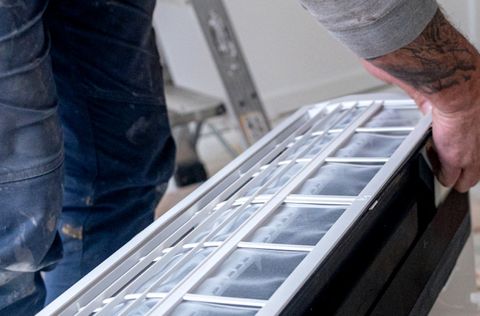
- Running and testing the pipe to each room.
- Electrical work, including any three phase check.
- Commissioning each indoor unit and showing you the controls.
Questions to ask the installer
- How many indoor units can this outdoor unit run, and could I add one later?
- If one indoor unit needs repair, can the others keep running?
- Does the technician hold a full RAC01 licence?
- How will the pipes get to each room, and where will they show?
- Would separate splits suit my home better, and why or why not?
What we'd do
Where we'd land
If you want three or four rooms comfortable and there's only one good spot outside, we'd lean towards a multi-split from an installer who fits them regularly. If the rooms are used at different times, or you'd rather a breakdown only took out one room, we'd get a quote for separate splits as well and compare the two side by side.