How does evaporative cooling work?
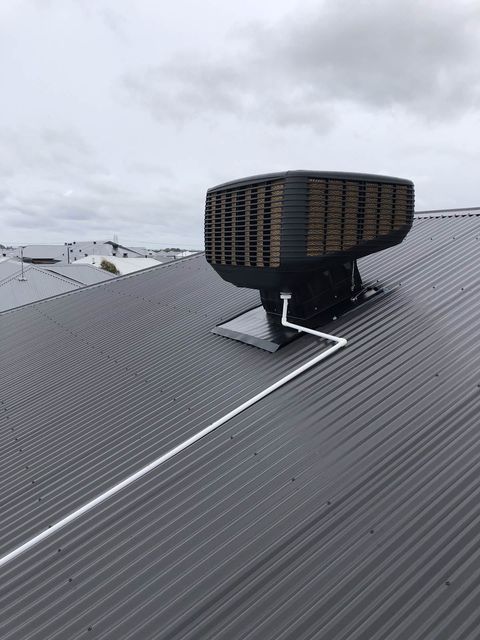
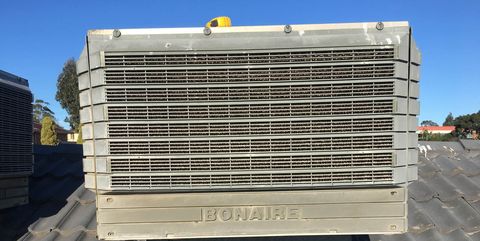
Seeley, the company behind Breezair and Braemar, explains it this way: hot air enters the roof unit, is filtered, and passes through moistened pads that cool it. A fan pushes the cooled air through the house, and the warm air leaves through open windows and doors.
That last step is the one people miss. Seeley says the cooled air isn't recirculated, so a door or window must be open for it to escape. It says the open area should be at least twice the size of the vent, using the windows or doors furthest from the vents, and that security vents are an alternative to an open window.
Does evaporative suit your climate?
| January afternoon humidity | What to expect | |
|---|---|---|
| Alice Springs Airport | 21% | Very dry, the conditions evaporative is built for |
| Mildura Airport | 25% | Dry inland heat |
| Adelaide (Kent Town) | 36% | Mostly dry summer afternoons |
| Perth Metro | 39% | Summer humidity is usually low |
| Melbourne Airport | 44% | In between: expect it to struggle on sticky days |
| Gold Coast Seaway | 70% | Humid: Seeley doesn't recommend evaporative in humid climates |
| Darwin Airport | 71% | Humid: CHOICE doesn't recommend it |
Those are Bureau of Meteorology averages at the stations named. The lower the humidity, the harder evaporative works for you. Seeley says that on humid days the air already holds too much moisture for evaporation to happen, and the Queensland Government advises turning the water pump off when regional humidity is above 65%.
Where it's common, and what it can't do
It's a familiar system in dry-summer states. The ABS found ducted evaporative was the most common cooling in Western Australian households in October 2006, at 32%, and a 2021 survey of Victorian home owners in gas areas found 23% had ducted evaporative.
It doesn't heat. Seeley presents evaporative as a cooling-only choice that needs a water supply connection, while reverse cycle covers winter as well. Pair it with ducted heating or splits, or if you're on a humid coast, read our evaporative or refrigerated guide first.
What an evaporative install involves
The roof unit goes up
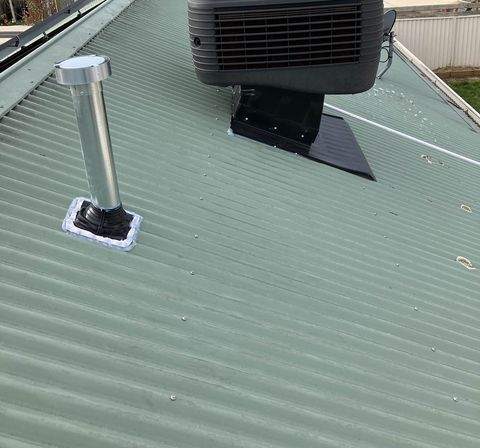
It sits over an opening cut for the main duct, on a mount that suits your roof.
Ducts and ceiling vents go in
Run through the roof space to vents in each room you want cooled.
Water, power and drain are connected
Seeley says the drain water is high in mineral salts and that the installer sets the constant bleed rate, the steady trickle of water drained off to carry those salts away.
It's commissioned
The installer runs it, checks the pads soak evenly, and shows you which windows to open.
What makes the job bigger or smaller
Replacing an old cooler on the same roof opening and ducts is usually simpler than a first install. The job grows with a second storey, a steep or tiled roof, more outlets, old ducts that need replacing, or long runs to the water and power.
An evaporative specialist will look at your windows as carefully as your roof, because Seeley's own troubleshooting starts with whether the exhaust area is big enough. A cooler can't push air into a house that has nowhere to let it out.
Noise rules and rentals in Victoria
EPA Victoria's noise rules name evaporative coolers. One used for cooling must not be heard inside a neighbour's habitable room on weekdays before 7am or after 11pm, or on weekends and public holidays before 9am or after 11pm. Ask where the roof unit will sit relative to next door's bedrooms.
For rentals, Consumer Affairs Victoria says an existing ducted evaporative cooler that fails and can't be repaired can be replaced with another ducted evaporative cooler with an outlet in the main living area, or upgraded to a compliant fixed cooler.
Check the warranty conditions
Brand warranties can depend on where you buy. Seeley says its 7 year Breezair and Braemar warranty applies only when the cooler is first bought through a Seeley participating dealer, and that otherwise residential use gets 5 years. It also describes a compulsory chargeable service in the fourth year on Breezair Supercool. We're not a dealer for any cooler brand, so ask the installer to show you the conditions in writing.
Questions to ask before you say yes
- Will evaporative really cope with our summers, or should we look at refrigerated?
- How many outlets, and where will they go?
- Where will the roof unit sit, and how close is it to the neighbours?
- Which windows or vents do we open, and is that enough exhaust area?
- Who does the water and electrical connections?
- Does this cooler get the brand's full warranty bought through you, and what servicing does that require?
- Is removing the old unit included?
What's yours to do, and what's the installer's
You can
- Open windows or doors on the far side of the house from the vents.
- Do Seeley's tissue test: a tissue held to the fly screen shouldn't stick while the cooler runs.
- On humid days, run it in fan mode, or early in the morning and late in the evening.
- Plan your winter heating separately.
Leave to a licensed installer
- Anything on the roof, from fitting the unit to servicing it.
- Cutting the roof opening and running ducts.
- The water connection and drain.
- The power supply and the wiring for the wall control.
What we'd do
If it were our home
If we lived somewhere with dry summer afternoons, we'd give evaporative a serious look for the fresh air and the open-window feel, and sort heating separately. On a humid coast, we wouldn't. Either way, we'd want an evaporative specialist to plan the exhaust windows as carefully as the roof unit.