Is your climate dry enough?
CHOICE says evaporative coolers are most effective in hot, dry climates with low humidity, and doesn't recommend them for humid or wet ones. Bureau of Meteorology averages put January afternoon humidity at 21% at Alice Springs Airport and 37% at Canberra Airport, which is good evaporative country.
Coastal Queensland sits at the other end. The Gold Coast Seaway station averages 70% afternoon humidity in January, and the Queensland Government advises turning a cooler's water pump off once humidity is above 65%.
If you're unsure which side of that line you're on, our guide to evaporative or refrigerated cooling walks through the trade-off.
Can your house let the air out?
An evaporative cooler pushes outside air in, so the house has to let the same amount out. Seeley says the open area should be at least twice the size of the vent, using the windows or doors furthest from the vents.
Seeley also says security vents are an alternative to leaving a window or outside door open. A house you're happy to leave a few windows ajar in suits evaporative well. One you'd rather keep locked up during the day needs security vents planned in from the start.
Pads, water and the cabinet
Ask which pads it uses
Pads are the wet filter the air passes through. Seeley says its Chillcel pads should last 7 or 8 years, and aspen or woodwool pads 3 or 4 years.
Choose bleed or drain valve
Seeley says coolers with a bleed system, which drains off a steady trickle of water, need seasonal maintenance before and after summer. Its drain-valve units don't need seasonal maintenance, but still need maintenance checks. The installer sets the bleed rate.
Think about where the water goes
Seeley says the drained water carries high levels of mineral salts, so check with a garden centre before you put it on plants. The cooler also needs a water supply connected to it.
Look at the cabinet
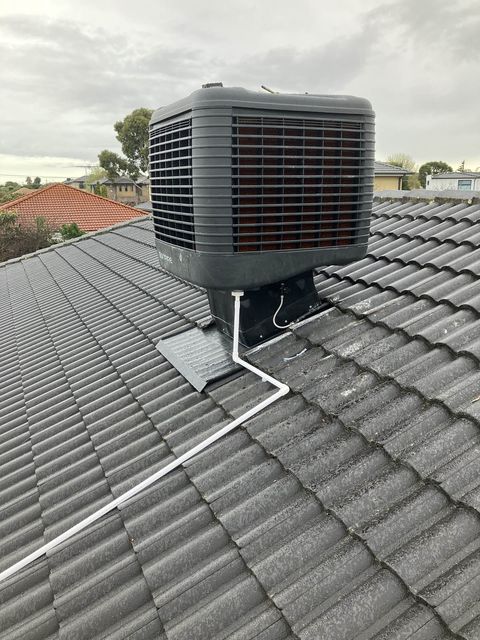
The cooler faces the weather all year. Seeley says Breezair developed the first all-plastic rooftop cooler made not to corrode, and gives its Permatuf cabinets 25 year cover against corrosion. Other makers describe their own materials, so ask about the one you're quoted.
Servicing and the warranty
Seeley says its evaporative coolers should be serviced after the first year and then every two years, by the installer or an authorised Seeley service company, and more often in harsh environments. Build that into the decision, because some warranties depend on it.
Seeley says Breezair coolers carry a 7 year warranty, but only when first bought through a Seeley International participating dealer; otherwise residential cover is 5 years. It describes the Breezair Supercool warranty as including a compulsory chargeable service in the fourth year, and asks owners to register within the first 6 months.
Bonaire offers a two-year warranty extension if you apply within 6 months of installation, and says servicing by technicians it hasn't employed or authorised isn't accepted for the extension. We're not a dealer for any brand, so read the conditions on whichever model you're quoted.
Stay off the roof
The cooler, its pads and its water connection are all up on the roof. Don't climb up to check or clean any of it, and if you ever go into the roof space, keep off the ceiling: WorkSafe Victoria reports workers falling through plaster ceilings. Switching the cooler off at its wall control is as far as a homeowner needs to go.
What's yours, and what's the installer's
You can
- If it's blowing warm air, check the wall control is set to cool and the water supply is on. Those are Seeley's first checks.
- Open windows or doors at the far end of the house from the vents.
- Try Seeley's door test: on high fan, a door should stay slightly ajar without slamming shut. If it slams, open more windows.
- Register the warranty, and put the service dates in your calendar.
Leave to a licensed installer
- Choosing where the cooler sits on the roof and how the ducts run.
- The water connection and the bleed rate.
- Pad replacement and anything else on the roof.
- The cooler's electrical connection.
Questions to ask the installer
- How have you sized it for our floor plan and the number of outlets?
- Which pads does it use, and how long should they last?
- Is it a bleed system or a drain valve, and what seasonal maintenance does that mean for us?
- Where will the air go out, and do we need security vents?
- What servicing does the warranty require, and when?
- Will the cooler sit somewhere a technician can reach safely?
What we'd do
If it were our home
We'd only choose evaporative with dry summers and a house we're happy to open up. Then we'd choose on the things that decide the next decade: pads that last, a water system we're willing to look after, and a warranty whose servicing we'll actually book. And we'd want an evaporative specialist, someone who's on roofs fitting and servicing coolers every week, to plan the exhaust before they plan the unit.