
Hobart, Tasmania
Heating and cooling in HobartMostly heating, by the Derwent.
In Hobart, heating is the main job and cooling is the occasional extra. Bureau of Meteorology averages for Battery Point give a July low of 5.2 degrees and a January high of just 22.7, and the national energy label map puts Hobart in its cold zone. A reverse cycle system, often called a heat pump in Tasmania, handles both.
Hobart's climate, homes and energy
Temperatures
Battery Point averages 22.7 degrees in January and 22.2 in February, with a July low of 5.2 (1991 to 2020). Hobart Airport at Cambridge, on the eastern shore, averages 23.1 in January and a July low of 4.4.
Cool summers, hot northerlies
Hobart's summers are cool for its latitude, but strong northerly winds from the outback can still push temperatures above 35 degrees. Light frost turns up most years, though air frosts are uncommon.
Climate zone
NCC climate zone 7, cool temperate, like every Tasmanian location in the table.
The Derwent
The city sits on the Derwent estuary, with beaches such as Bellerive, Kingston and Long Beach. The Galvanizers Association rates harbour foreshores and the first 50 m back from a sheltered bay C4 for corrosion, and 50 m to 1 km back C3.
Homes
At the 2021 Census, Greater Hobart's occupied homes were 85.1% separate houses, 6.1% semis, terraces or townhouses and 8.2% flats or apartments, and 28.8% were rented. Weatherboard and fibro bungalows and post-war houses are common, and Battery Point keeps many early attached cottages.
Energy
TasNetworks runs the state's electricity network and serves more than 300,000 customers. Tas Gas Networks has laid gas through Hobart's urban areas since 2003, and gas is available to more than 58,000 Tasmanian properties.
What's different about heating and cooling in Hobart
Heating carries the load. The energy label on a split shows a rating for each climate zone, and the cold-zone heating rating is the one that applies here, along with the heating capacity at 2 degrees. Cooling is for the hot northerly days, so a system bought mainly on its cooling stars has the priorities the wrong way round for Hobart.
Gas is less of a given than in Victoria. It reached Hobart's streets from 2003, and the properties it's available to are a fraction of the customers on the electricity network, so check whether gas is even on offer at your address. Heat pumps are the efficient electric option: the ACT Government's guide puts reverse cycle at 370% to 600% efficiency, against 100% for an electric element heater.
In Hobart's older weatherboard and fibro bungalows, Rinnai's point that good insulation holds the temperature is worth taking seriously before anyone sizes a system.
The jobs that come up most in Hobart, and why
Heat pumps for the living area. A split system is the natural first step, heating the room the household uses most.
Whole-home heating. In bigger houses, ducted heating in Hobart can be a gas furnace or a ducted heat pump.
Servicing before winter. A heat pump that runs for months earns its yearly service in Hobart, with a salt check near the water.
Apartments. 8.2% of Greater Hobart homes are flats or apartments, where body corporate approval and somewhere to put the outdoor unit come first. See apartments and strata.
Tasmanian rules worth knowing
In Tasmania, installing, servicing, repairing or removing refrigerated air conditioning is prescribed plumbing work under the Occupational Licensing (Plumbing Work) Regulations 2021, and electrical and gas-fitting work are licensed under the same Act. That's on top of the national ARC refrigerant licence.
Anyone offering to contract for that work must hold a contractor's licence of the right occupation and class, under s 38(2) of the Occupational Licensing Act 2005. Ask to see it.
Noise has its own guideline. EPA Tasmania says a heat pump shouldn't be louder than 45dB(A) from 7am to 10pm, or 40dB(A) from 10pm to 7am, measured one metre from the neighbour's nearest external wall, and noise at any hour can still be found unreasonable.
Rentals must have a heating device in a room that can be the main living area: a fixed electric or gas heater, a heat pump, a wood heater (not an open fireplace), an approved open fireplace, or another prescribed device.
What we'd do
Our advice for Hobart homes
We'd buy for winter: a heat pump chosen on its cold-zone heating rating and its output at 2 degrees, put in the room you live in. Near the Derwent, we'd ask about coastal protection and keep the outdoor unit out of the spray. And we'd check the installer's Tasmanian licences before signing. Where we have a licence-checked heat pump specialist near you, we'll pass your job to them, and if we don't, we'll say so.
What this work looks like
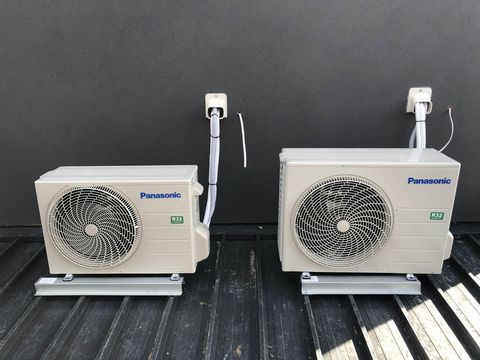
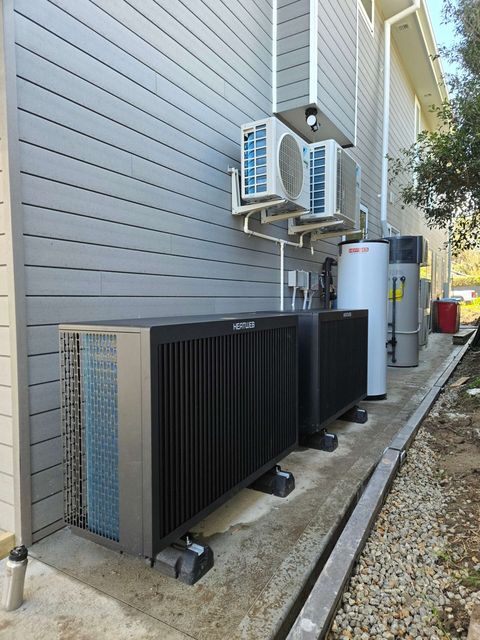
Photos from real jobs in Melbourne, to show what the work looks like. They aren't from an installer near you.

Heating and cooling jobs in Hobart
Suburbs and areas around Hobart
Questions people ask
Is a heat pump enough to heat a Hobart home?
Do I need cooling in Hobart?
How loud can my heat pump be for the neighbours?
Does a Hobart rental need a heater?
Ready for the right installer to take a look in Hobart?
Your postcode and three quick questions. Licence-checked local installers who specialise in your kind of job see it, and the one who takes it gets in touch to quote.
Read next
- 01Ducted heating in HobartDucted heating in Hobart: gas or heat pump, ducts in older homes, safety checks and Tasmanian licences.
- 02Air conditioning and heat pump service in HobartHeat pump servicing in Hobart: autumn timing, Derwent salt, what's checked and the licences needed.
- 03Split system installationWhen a split suits your home, how to size it, and what a good install includes.
- 04Heat pumps for heatingHow reverse cycle heats from outside air, and how it copes on frosty mornings.
- 05Air conditioning near the coastSalt, coil coatings, warranty fine print and where the outdoor unit should go near the sea.
- 06Heating and cooling in TasmaniaTasmania's plumbing licence rule for heat pumps, the missing licence numbers, noise limits and rentals.
Where this information comes from
- Wikipedia (climate tables cite Bureau of Meteorology) Hobart, 28 October 2026
- Australian Building Codes Board NCC 2016 Volume One, Part A1 Interpretation: Table A1.1 Climate zones for thermal design, various locations, 28 October 2026
- Wikipedia River Derwent (Tasmania), 28 October 2026
- Galvanizers Association of Australia Corrosivity of the Environment: A Quick Guide (categories as defined in AS/NZS 2312.2 and described in AS 4312), 28 October 2026
- Australian Bureau of Statistics 2021 Census All persons QuickStats: Greater Hobart (GCCSA 6GHOB), 28 October 2026
- Wikipedia Terraced houses in Australia, 28 October 2026
- TasNetworks About us, 28 October 2026
- Tas Gas Networks About us, 28 October 2026
- ACT Government, Sustainable Household Scheme Heating and cooling your home: a guide to reverse cycle systems (PDF), 27 March 2023
- Rinnai Australia Ultimate split system air conditioner size guide, 28 October 2026
- Tasmanian Legislation Online Occupational Licensing (Plumbing Work) Regulations 2021 (current), 28 October 2026
- Tasmanian Legislation Online Occupational Licensing Act 2005 (current), 28 October 2026
- EPA Tasmania Guidelines for Heat Pumps and Air Conditioners, 28 October 2026
- Tasmanian Legislation Online Residential Tenancy Act 1997 (current), 28 October 2026
- Australian Refrigeration Council Fact Sheet 13: Who can do what, with Split System Air Conditioners (ARC5919/JVD/0726), 28 October 2026
We don't publish prices. Every home is different, so an installer's written quote is the only real number. How we write and check these pages.