Why approval comes first
The Good Guys says body corporate approval is required before any work takes place in a multi-storey apartment block. It's a sensible rule for anyone, because walls, balconies and roofs are often common property.
Rules differ between states and buildings, so ask your strata or building manager for the by-laws on air conditioners before you get quotes. Some buildings set where outdoor units may go and how pipes must be covered.
Landlords, note that Victoria's rental minimum standards list owners corporation rules among the grounds that can make installing a new energy efficient heater unreasonable.
How an apartment install usually goes
Read the by-laws
Find out what the building allows and what it wants with an application.
Get a site visit
The installer looks at where the outdoor unit can sit, the route for the pipes and drain, and your apartment's switchboard.
Apply to the owners corporation
Send the installer's written proposal: unit positions, mounting, pipe route and noise. The energy label lists the indoor and outdoor units' sound power levels, which helps.
Book the work
Once approved, check whether the building needs a lift booking or set work hours.
Where can the outdoor unit go?
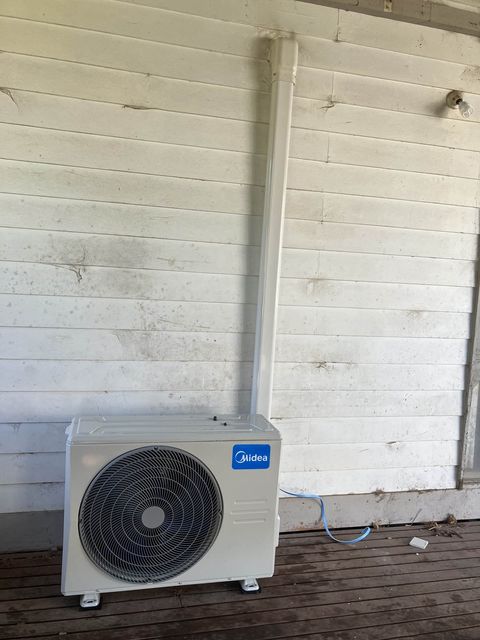
Usually a balcony, a plant deck or the roof, a bracket on an external wall, or a shared services area.
The ACT Government's guide says to think about access for maintenance, noise reaching neighbours and fresh air reaching the outdoor unit, and to avoid enclosed courtyards and slat fencing around it. A balcony screened in on every side can have the same problem.
Reaching the unit later matters for the warranty. Mitsubishi Heavy Industries' terms say equipment must be safely accessible with a 1.7 metre ladder, with extra access the owner's responsibility, and LG's warranty excludes extra costs to reach units in restricted or unsafe locations.
Several rooms to cool and little balcony space? A multi-split runs several indoor units from one outdoor unit.
Noise and the neighbours
Neighbours are closer in a block, so noise rules come into play sooner. In the ACT, noise from a home in a multi-unit development must be 5 dB(A) quieter than the limit for its zone.
In Victoria, cooling mustn't be heard inside a neighbour's habitable room after 11pm, or before 7am on weekdays and 9am on weekends and public holidays. For heating, the evening cut-off is 10pm.
Queensland's default standard limits air conditioner noise to 5 dB(A) above background from 7am to 10pm, and 3 dB(A) above background overnight, unless the council sets its own. Our noise guide covers other states.
Your jobs, and the installer's
You can
- Get the by-laws and any approval form from your strata manager.
- Measure the balcony or outdoor area and note what's already on it.
- Talk early to neighbours on shared walls if a unit will sit near their windows.
Leave to a licensed installer
- Proposing unit positions the building can approve.
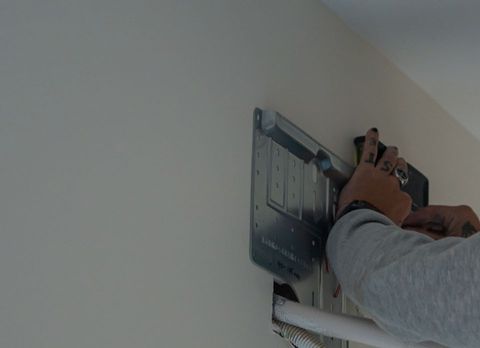
- Pipe and drain routes through walls, slabs or service risers.
- Working at height on balconies, brackets or roofs.
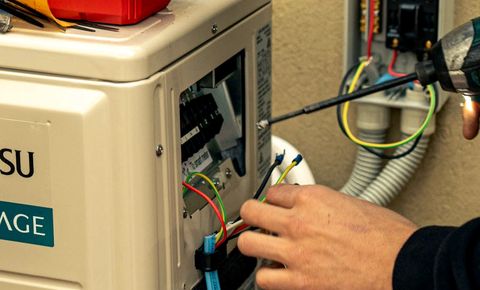
- The electrical and refrigerant work, and the compliance certificates.
What we'd do
Where we'd start
We'd get the by-laws before the first quote, then ask an installer who does apartment work regularly to put the proposal in writing for the owners corporation. We'd also make sure the outdoor spot can be reached safely for servicing, because a unit no technician can get to becomes a problem every year after.