Why Adelaide's summers suit it
An evaporative cooler pulls outside air through wet pads, and the evaporating water takes heat out of that air. It only works well when the air is dry enough to take up more water. CHOICE says these coolers are most effective in hot, dry climates with low humidity, and Adelaide's hottest days tend to come on northerlies out of central Australia.
Humidity still varies across the city. Belair, in the foothills, averages 46% on January afternoons against 36% at Kent Town and Adelaide Airport. The Queensland Government's guidance says evaporative coolers become less effective as humidity rises, and to turn the water pump off once humidity passes 65%.
What it means in an Adelaide home
Long hot spells
Through a run like the 15 days of 35 degrees or more in March 2008, an evaporative system keeps pushing fresh air through the house rather than recirculating it. Seeley says its system changes all the air in a home at least every two minutes.
Windows open
The air has to escape somewhere. Seeley says the open area should be at least twice the size of the vent, using the windows or doors furthest from the vents, and that security vents can stand in for open windows at night.
The roof
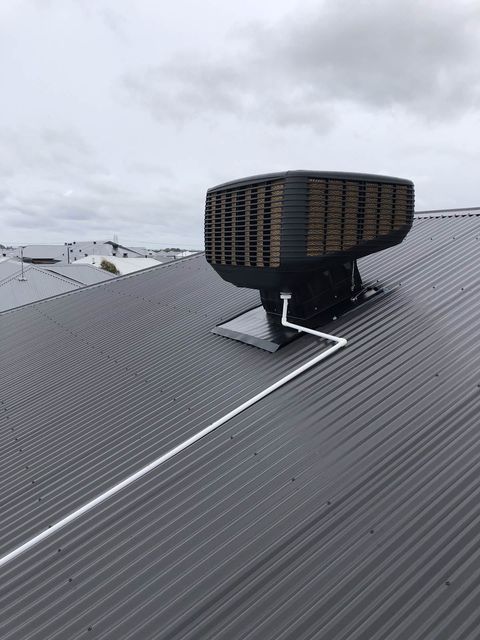
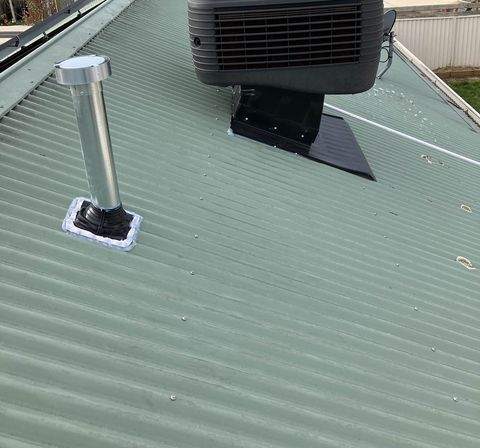
The suburbs grew mostly as single-storey houses, a layout that suits a roof unit with short duct runs down to a ceiling vent in each room.
Winter
It only cools. With a July mean minimum of 7.7 degrees at Kent Town and frosts in the Hills valleys, you'll want gas heating, reverse cycle or another heater alongside it.
Water and drain
Seeley says the drain water is high in mineral salts, so check with a garden centre before using it on plants. The installer sets the bleed rate, the steady trickle that carries those salts away.
Evaporative or refrigerated in Adelaide?
| Evaporative | Reverse cycle | |
|---|---|---|
| Hot, dry afternoons | Works well | Works well |
| Humid days | Loses effect as humidity rises | Keeps cooling with the house shut |
| Windows | Open while it runs | Closed while it runs |
| Winter | No heating | Heats as well |
| Servicing | Seeley says after the first year, then every two years | Mitsubishi Electric recommends yearly |
What makes an evaporative job bigger or smaller
Replacing an old roof unit on ducts that are still sound is the smaller job. A new system means a roof opening, ducts to each room, a water line and a drain. Old ducts that are squashed or poorly insulated may be worth replacing at the same time.
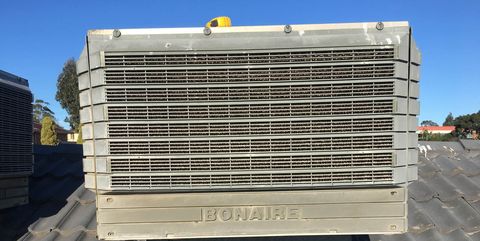
Pads are the ongoing item. Seeley says its Chillcel pads should last 7 or 8 years, and aspen or woodwool pads 3 or 4. Noise is worth a thought too: South Australia's local nuisance rule covers noise from fixed machinery at a home, so ask where the roof unit will sit relative to the neighbours. The national evaporative cooling page covers the install steps.
Questions to ask an evaporative installer
- Does my home suit evaporative, given where it sits and how it's built?
- How many outlets will I get, and in which rooms?
- How will the house vent at night if I don't want windows open?
- What bleed rate will you set, and where will the drain water go?
- How often does this model need servicing, and what does the warranty require?
What we'd do
If it were our home
In a single-storey Adelaide house where summer comfort is the priority, we'd get an evaporative quote alongside a ducted reverse cycle one, each from a specialist in that system. Evaporative earns its keep on dry heat days, while reverse cycle copes with the sticky days and the winter. If you already have gas heating you're happy with, evaporative beside it is a sensible pairing.
Tell us about your home and your postcode. Local, licence-checked installers who fit evaporative systems will see it, and only the installer who takes the job is sent your contact details. Our Adelaide page has the wider picture.