Why Adelaide systems need the service
Hard summer days
Adelaide can usually expect several days a year in the mid to high 30s to low 40s, and the 2017 to 2018 summer had 5 days of 40 degrees or more. Those are the days a dirty coil or a tired fan gives itself away.
Heat takes capacity
ActronAir says an air conditioner loses cooling capacity above 35 degrees, giving the example of a 14kW system dropping to 10kW or 12kW. A service can't change the weather, but it stops dust and grime taking even more off the top.
Two seasons of running
With a July mean minimum of 7.4 degrees at Adelaide Airport (Bureau of Meteorology, 1991 to 2020), plenty of reverse cycle systems here heat for months too. That's far more running hours than a unit that only cools.
Close to the gulf
Under AS 4312, the Galvanizers Association of Australia rates land from 100 m to 3 to 6 km inland from a less sheltered bay or gulf as C3, coastal, and the edge of calm salt water as C4. Outdoor units in the beachside suburbs deserve a closer look at every visit.
What makes a service bigger or smaller here
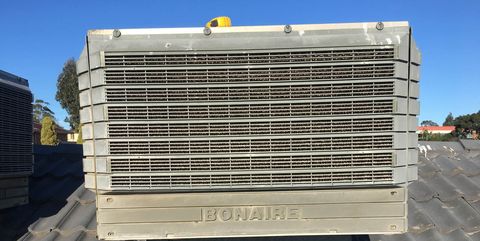
A wall split whose filters have been cleaned regularly is a short job. A ducted system that hasn't been touched in years, with a clogged return air filter, takes longer, and so does an outdoor unit tucked into a narrow side passage where leaves and garden clippings collect.
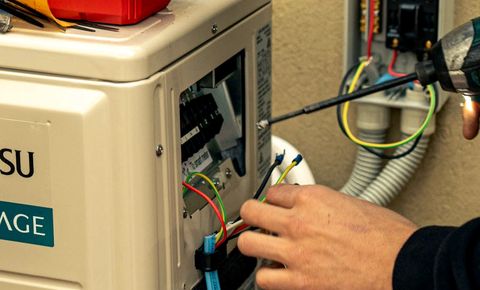
Daikin's start-of-summer tune-up list is a good benchmark for what you're paying for: coils cleaned, the refrigerant charge checked, electrical connections tightened, drains flushed and any ductwork inspected. If the technician finds a refrigerant leak, that becomes a repair. The ARC says topping up before leaks are found and fixed is illegal.
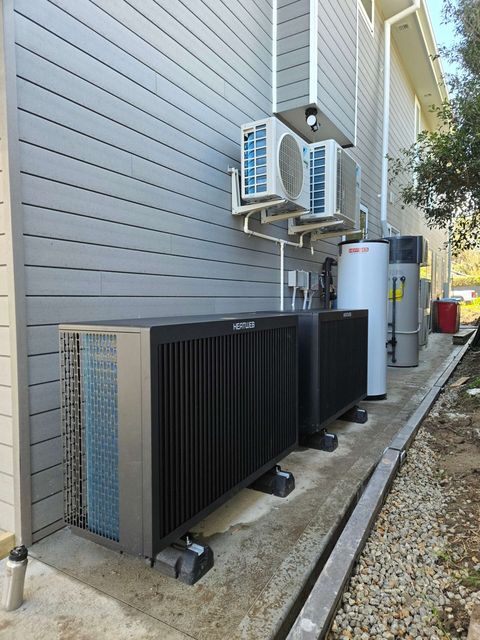
Near the water, Daikin says proper maintenance and positioning are essential for coils exposed to sea spray, and its warranty card puts extra corrosion protection in sea air on the owner. So ask for the outdoor coil fins to be checked, not just the filters. The national air conditioning service page covers what a full service includes anywhere.
Your part between services
You can
- Clean the filters as your manual says. Daikin's general rule is every two weeks, and at least monthly through summer.
- Switch off at the isolator or breaker before cleaning, as Mitsubishi Electric advises.
- Keep the outdoor unit clear of leaves, pot plants and anything stored against it.
- Write down anything odd, like a smell, a drip or a new noise, so the technician knows where to look.
Leave to a licensed installer
- Cleaning the coil and fan inside the indoor unit. Mitsubishi Electric says owners should never wash the inside themselves.
- Checking the refrigerant, which needs an ARC licence.
- Tightening electrical connections and testing the controls.
- Flushing the condensate drain (the small pipe that carries water away from the indoor unit).
Questions to ask the technician
- Is the outdoor coil cleaned as well as the indoor unit?
- Do you hold a full RAC01 licence, in case the refrigerant needs work?
- Will you test heating mode too, not just cooling?
- For a home near the beach, what corrosion can you see on the outdoor unit, and what would you do about it?
- Does my warranty need a yearly service record from you?
What we'd do
Our take
We'd book in September or October, have both the heating and cooling modes checked, and ask for the outdoor coil to be cleaned if you live anywhere near the water. Use someone who services your type of system every week: a ducted specialist for ducted, a split technician for wall units.
Tell us what you've got and your postcode. Licence-checked technicians who service that kind of system in your part of Adelaide can see the job, and only the one who takes it receives your contact details. Should no Adelaide technician take the service within 48 hours, it may be shown to technicians in other parts of South Australia.