Why Canberra suits evaporative, mostly
Low summer humidity
Afternoon humidity at Canberra Airport averages 37% in January and 47% across the year. Seeley says that when the air already holds a lot of moisture, evaporation can't do its job, so dry afternoons are when a cooler earns its place.
A short run of hot days
Long-term averages give Canberra about 30 days a year at 30 degrees or more and 4 at 35 or more. Some summers are harsher: the ABS counted 13 days at 35 or more in 2006, and the record is 44.0 degrees on 4 January 2020.
Winters that need real heating
Canberra is NCC climate zone 7, cool temperate, and the ACT Government says heating is about 60% of the average household's energy use. An evaporative cooler sits idle for all of that.
The gas question
New gas network connections have been prevented in ACT residential zones since 8 December 2023. Pairing evaporative cooling with gas ducted heating only works where gas is already connected.
Evaporative or reverse cycle in Canberra?
That's the real decision here. Reverse cycle heats and cools from one system, and the ACT Government says it can be the cheapest heating to run. Evaporative only cools, needs a water connection and wants windows open, but it pushes fresh outside air through the house rather than recirculating it.
If you're keeping a gas ducted heater, or you already have reverse cycle heating you like, an evaporative cooler for summer can make sense. If you're starting over with no gas, one reverse cycle system covers both seasons with less on the roof. Our evaporative or refrigerated guide goes through the trade-offs.
What makes a Canberra evaporative job bigger or smaller
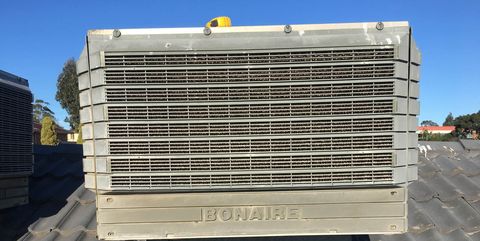
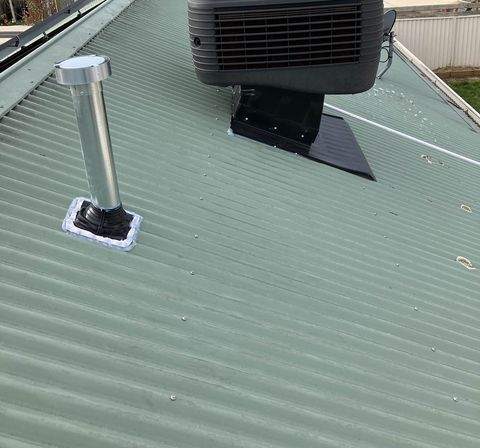
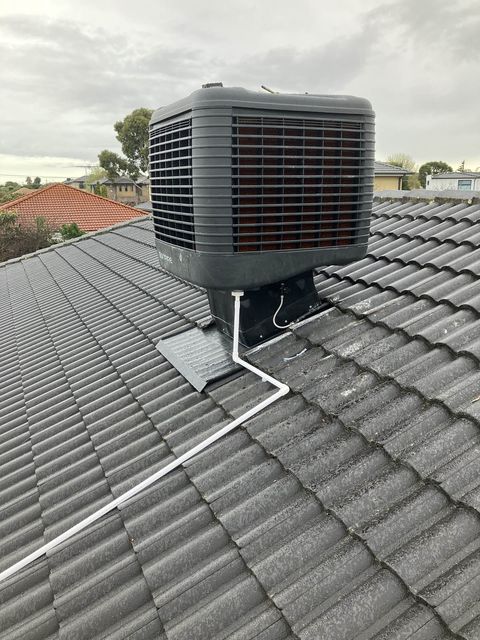
Swapping an old cooler onto the same roof opening and ducts is the simpler job. A first install means cutting a roof opening, running ducts to ceiling outlets, and bringing water and power up to the roof.
In a Mr Fluffy era home (1968 to 1978-79), cutting that opening and running ducts disturbs a roof space where loose-fill asbestos fibres stayed. Check for the safety tag at the meter box before anyone comes to quote.
Plan the windows as well. Seeley wants the open window or door area at least double the vent area, on the far side of the house from the outlets, and suggests security vents if you'd rather not leave a window open.
Mind the neighbours. ACT residential noise limits drop to 35 dB(A) at 10pm, so ask where the roof unit will sit relative to next door's bedrooms.
Questions for a Canberra evaporative installer
- How many outlets, and in which rooms?
- Can the existing roof opening and ducting be reused, or does it all need replacing?
- Which windows or vents will we need open, and is that enough exhaust area?
- How will you work in the roof space if this could be a Mr Fluffy house?
- What servicing does the brand's warranty require?
- What heating would you pair this with in our home?
What's yours, and what's the installer's
You can
- Check the humidity on the forecast. On a muggy day, Seeley suggests ventilation mode with the fan on high.
- Open windows on the side of the house furthest from the vents while it runs.
- Treat your winter heating as a separate decision.
- Book a service before the first hot week, not during it.
Leave to a licensed installer
- Everything on the roof.
- Cutting the roof opening and running ducts and outlets.
- The water, drain and power connections.
- Setting the bleed rate, which Seeley says the installer sets.
What we'd do
Where we'd start
We'd start with the heating, because that's most of a Canberra year. With a gas or reverse cycle heating system you're keeping, an evaporative cooler is a sensible way to handle dry summer afternoons. If everything's being replaced and there's no gas, we'd get a reverse cycle quote alongside, since one system can do both. Either way, we'd want an evaporative specialist to plan the exhaust windows and check the roof space before quoting.