Canberra details that change a split install
Lots of medium-density homes
At the 2021 Census, 19.4% of ACT homes were flats or apartments and 17.2% were semis, terraces or townhouses. A flat usually has no roof space for ducted, so a wall split is where the conversation starts.
Neighbours close by
ACT noise limits for residential areas are 45 dB(A) during the day and 35 dB(A) from 10pm to 7am, Monday to Saturday. In a multi-unit development, your noise must come in 5 dB(A) below the zone limit.
Heritage streets
In the Braddon Garden City heritage precinct, roof elements on identified homes, air conditioners included, must be sited to minimise how much of them shows from the street or nearby public areas. Canberra's other early Garden City precincts include Alt Crescent, Barton, Blandfordia 5, Corroboree Park, Forrest, Kingston/Griffith, Reid and Wakefield Gardens, so check what applies on your street.
Cold mornings
July's mean daily minimum at the Canberra Airport Comparison station is 0.3 degrees. On the energy label, look for the heating capacity at 2 degrees, the colder test point.
How big, and how many?
The ACT Government's buyers guide says splits suit houses under 180 sqm, or homes that only need some rooms done, and that a large split can look after an area of up to 80m2. Each bedroom you want warm on a winter night needs its own unit, or a head on a multi-split.
Have it sized from a heat load, not picked off the shelf. Mitsubishi Electric lists building orientation, insulation and windows among the factors a heat load has to cover, which is why a shaded south bedroom and a sunny north-facing lounge get different answers. Our size calculator gives a first estimate.
Where the outdoor unit goes
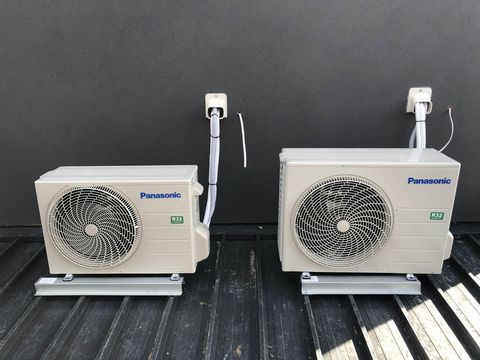
The ACT guide says to keep the outdoor unit out of enclosed courtyards, never to surround it with slat fencing, and to leave easy access for maintenance. On a tight townhouse block, that can rule out the spot that looks neatest.
Then look over the fence. With a 35 dB(A) overnight limit, a unit running on heat under a neighbour's bedroom window on a winter night is asking for a complaint.
In a strata complex, the owners corporation may have its own say on where units go. Our apartments and strata page covers what to ask before you book.
Licences and the electrical side
An installer with the ARC's restricted RSS03 licence can fit a single-head split under 18kW, while multi-head systems need a full RAC01 holder. In the ACT, running a new circuit is low voltage wiring work that needs an unrestricted electrical licence, and the outdoor unit needs a lockable isolating switch beside it rather than on it.
What you can sort out, and what needs a licence
You can
- List the rooms you heat on winter nights and the ones you cool in summer.
- Walk the outside walls and spot where an outdoor unit could breathe, away from bedroom windows next door.
- Find out whether your street sits in a heritage precinct before settling on a roof or street-facing spot.
- Once it's in, keep the filters clean as the manual says.
Leave to a licensed installer
- The heat load and the final size.
- Refrigerant pipework, leak testing and commissioning.
- The new circuit and the isolator, by a licensed electrician.
- The wall penetration and the fall on the drain.
Questions to ask before you say yes
- What's the heating capacity at 2 degrees, and is the model H2 rated?
- Exactly where will the outdoor unit sit, and what are its noise figures?
- Is your electrician licensed for new wiring in the ACT?
- What's your RTA number for the quote?
What we'd do
Where we'd start
We'd work out which rooms matter on a July night, get each sized from a heat load, and choose models on their heating capacity at 2 degrees. Before agreeing to an outdoor unit spot, we'd stand there and look at what's over the fence. A split specialist who works in Canberra townhouses and flats all the time will already know the noise and access traps.