What wears a Sydney air conditioner
Salt on the coast
A corrosion guide based on AS 4312 rates harbour foreshores as C4 (calm sea-shore) and the strip within 200 m of surf beaches as C5 (surf sea-shore). ActronAir's terms describe the extra protection they want in sea air as regular washing down of the outdoor unit, panels and coils with a mild detergent.
Humid air and dirty filters
Observatory Hill's summer afternoons average 60% to 62% humidity. Mitsubishi Electric says dirty filters cause condensation inside the unit, which helps mould grow, and tells owners to clean them every 2 weeks.
A long season out west
Penrith averages 67 days a year above 30 degrees, against 15 in the CBD. A unit doing that much work through summer is the one you least want failing in January.
Heating season in the west and the mountains
Richmond averages 38 nights a year below 2 degrees, and AdaptNSW says the upper Blue Mountains typically has more than 70. If your reverse cycle system is also your heater, it earns a check before winter as well.
When to book a service in Sydney
Daikin suggests having a licensed technician look over the unit at the start of every summer. For most of Sydney, that means booking in spring, before the first hot spell.
Mitsubishi Electric recommends a professional service once a year. If you mostly use the system for heating, in Richmond, Camden or the Blue Mountains say, book it in autumn instead.
Warranties can make the yearly visit a condition. ActronAir's terms set residential maintenance at once every 12 months, so keep each invoice with the warranty card. The national air conditioning service page covers what other brands ask.
Salt air, coil coatings and the warranty
Daikin says all its outdoor coils carry an anti-corrosion treatment it calls Blue Fin, and that maintenance and positioning still matter. Its warranty card still makes the owner responsible for extra corrosion protection in sea air.
So if you can see the harbour or hear the surf, ask for a wash-down of the outdoor unit at every service, and ask the technician to check the bracket and bolts as well as the coil. Our coastal homes guide goes into the detail.
What a Sydney service should cover
- Filters cleaned, and the indoor coil, fan and drain tray checked for dust and mould.
- The drain flushed, so summer condensation runs outside rather than down the wall.
- The refrigerant charge checked by an RAC01 licence holder.
- Electrical connections tightened and the controls tested.
- Near the coast, the outdoor coil washed down and the fixings checked for rust.
- A test run on cooling and, if you rely on it in winter, on heating.
- The business's RTA number on the invoice.
Between services
You can
- Clean the filters on your manual's schedule, with the power off. Daikin and Mitsubishi Electric both say about every 2 weeks.
- After cooling on a humid day, run FAN mode for a while; Mitsubishi Electric recommends it to dry the inside of the indoor unit.
- Keep plants, bins and stored things clear of the outdoor unit.
Leave to a licensed installer
- Cleaning the coil and fan inside the indoor unit.
- Anything to do with the refrigerant.
- Electrical checks.
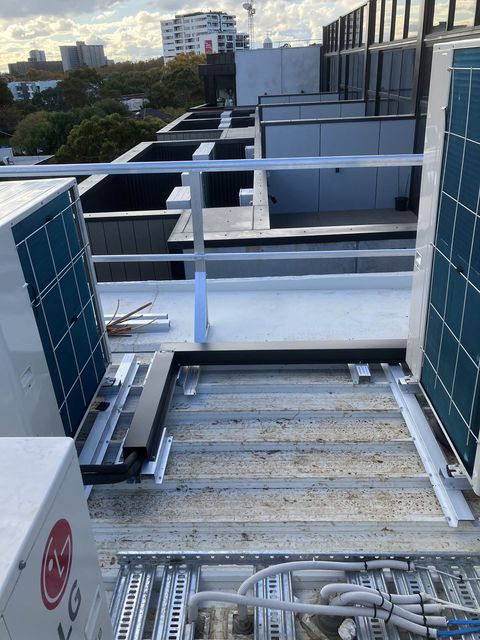
- Units on roofs, high walls or balcony brackets you can't reach from the floor.
Ask before you book a Sydney service
- Will someone with an RAC01 licence check the refrigerant?
- Is every indoor unit's coil and drain included, or just the filters?
- Will you rinse the outdoor coil and check the bracket and bolts for rust?
- If you find a fault, will you write it up separately for me to decide on?
What we'd do
What we'd book
We'd book a service every spring, add an autumn check if the system were our main heater out west, and ask for a coil wash-down every time if we lived near the water. The person we'd want is a service technician with an RAC01 licence who sees coastal and western Sydney units every week, and that's who we look for when we pass on a Sydney service job.