What Rockhampton's climate means for a service
Summer runs close to the limit
The Bureau of Meteorology's Rockhampton station records a mean daily maximum of 32.6 degrees in both December and January, and the average January's hottest day reaches 38.1. ActronAir says air conditioners lose cooling capacity above 35 degrees, so a unit with a dusty coil has less in reserve on those days.
August and September are the easy window
Average 3 pm humidity falls to 37% in August and September, the least humid afternoons of the year by Bureau of Meteorology averages. That stretch, well before the heat, is a sensible time to have the system opened up and checked.
The heating gets a workout too
July's mean minimum at the station is 10.6 degrees. If your reverse cycle system keeps the bedrooms comfortable on those nights, have it run in heating as well as cooling.
Low-set units on flood-prone blocks
Get Ready Queensland's flood advice includes lifting air conditioner units and switchboards above the flood level. If your outdoor unit sits where water has come up before, ask at the service what raising it would involve.
Salt is mostly a coastal worry
Salt air mainly troubles units near the sea, and Rockhampton sits about 45 km up the Fitzroy from the Coral Sea. A second unit at a place on the Capricorn Coast needs more attention than the one in town.
Why a yearly service pays off here
Mitsubishi Electric recommends a professional service once a year, and ActronAir's warranty terms set residential maintenance at once every 12 months. Skip a year and you may be reading the fine print in the middle of a January breakdown.
The heat is the local reason. Daikin says replacing a blocked filter with a clean one can lower energy use by 5% to 15%, and on an afternoon well past 35 degrees the unit has no spare effort to waste. Our air conditioning service page covers what a standard service includes.
What a technician should do on a Rockhampton service
Go past the filters
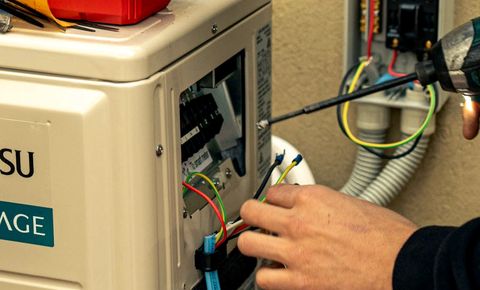
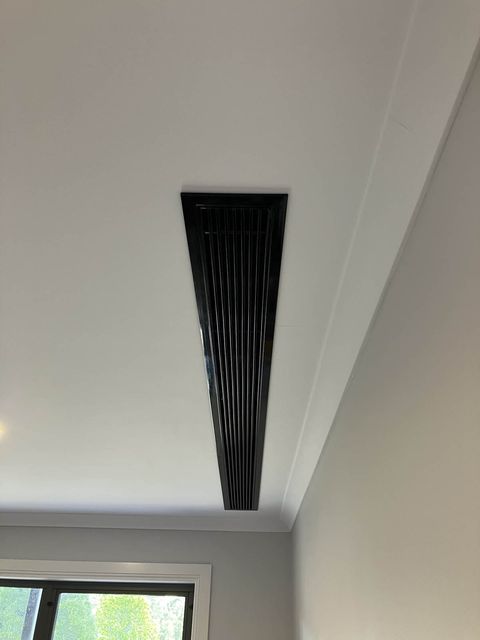
Daikin's start-of-summer tune-up takes in the coils, the refrigerant charge, the electrical connections, the drains and any ductwork.
Run it in both modes
Cooling first, then heating, so you know the reverse cycle side works before July.
Look over the outdoor unit
Clear debris, check the fixings, and note whether it sits low on a flood-prone part of the block.
Check the refrigerant charge properly
If it's low, there's a leak to find. The ARC says topping up before the system's been fully tested and the leaks repaired is illegal.
Questions to ask a Rockhampton technician
- Do you hold an RAC01 licence for checking the refrigerant?
- What's your QBCC licence number?
- Will you test the heating as well as the cooling?
- Is my outdoor unit sitting at a sensible height for this block?
- Will any faults be written up separately for me to think over?
Your part between visits
You can
- Clean the filters every couple of weeks while it's working hard. Daikin suggests at least monthly through summer.
- Switch off at the isolator or breaker before you take the filters out.
- Keep mulch, garden growth and stored gear away from the outdoor unit.
Leave to a licensed installer
- Cleaning the coil, fan and drain inside the indoor unit.
- Checking the refrigerant and finding any leak.
- Raising a unit above flood level, with an electrician for the wiring.
Who's licensed to service it
The QBCC's definition of mechanical services work includes the maintenance, testing and repair of air conditioning, and in Queensland that work needs a QBCC licence at any job value. Anything that touches the refrigerant needs a full RAC01 holder, because the restricted RSS03 licence doesn't cover service work on the refrigerant.
Where we have them near you, licence-checked local technicians who service split and ducted systems as their everyday work see service jobs, and only the one who takes yours gets your contact details. If we don't, we'll say so. There's more about the town on our Rockhampton page.
What we'd do
What we'd do in Rockhampton
Book the service for August or September, while humidity is at its lowest and well before the heat, and ask for both modes to be tested. Clean the filters yourself through the hot months. If the outdoor unit sits low on a block that's flooded, ask about raising it while the technician is there.