Mackay facts that change the install
Humidity drives the size
February afternoons at the Bureau of Meteorology's Mackay Aero station average 72% humidity, with a dew point of 22.9 degrees. Rinnai says an oversized system can short cycle, switching on and off too often, and dehumidify less effectively.
Raised timber homes
Mackay Regional Council's heritage guide says almost all the region's heritage houses are single storey timber houses raised on stumps. On a house like that, the pipe run, the hole through the wall and the outdoor unit's spot all need thinking through.
Storm tide by the beaches
For homes in storm tide prone areas, the QRA recommends relocating all electrical wiring, the meter box and other installations above the adopted storm tide level. Council's storm surge maps include Midge Point, Seaforth and Armstrong Beach, among others.
On the zone boundary
The council area is climate zone 2 on the ABCB map, where the Queensland Government's aim is cooling for summer and some warmth for winter. July's mean minimum at Mackay Aero is 11.4 degrees.
No gas network listed
The Queensland Government's natural gas list doesn't include Mackay, so a reverse cycle system is likely to be your heating as well as your cooling.
Installing on a raised timber house
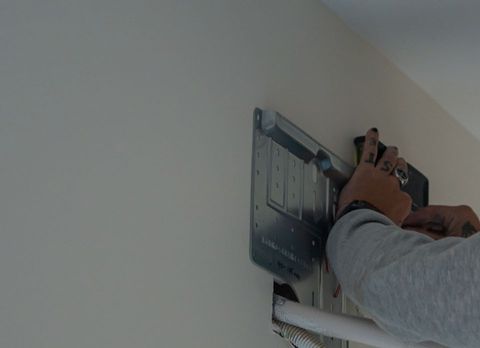
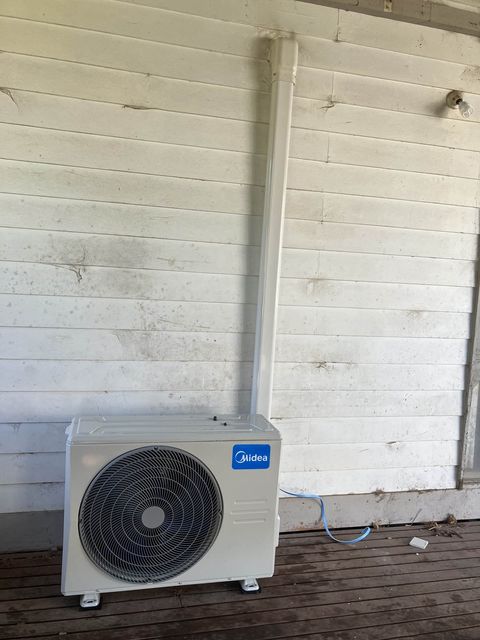
A house on stumps gives an installer choices. The pipes might run under the floor or along the outside under a cover, and the outdoor unit might sit on the ground beside the stumps or on a bracket. Each option trades off looks, access for servicing and the length of the pipe run.
Ask about two things in particular. First, how the hole through a timber wall will be sealed against wet-season rain: Samsung lists rainwater coming in through the wall hole as a cause of indoor leaks. Second, where the condensate drain (the small pipe that carries water away from the indoor unit) will empty, so it isn't dripping where water pools under the house.
What makes it bigger or smaller
Sizing. A heat load on each room, not a rule of thumb. ActronAir says tropical and subtropical areas have much greater demands than cooler regions, and warns that its own rough per-square-metre formula ignores many important factors.
Height. In a storm tide or flood area, lifting the outdoor unit and its electrics means a stand or bracket and more electrical work.
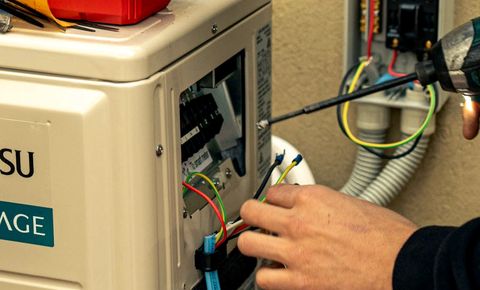
Power. Mitsubishi Electric says each unit needs a dedicated power supply, and an older switchboard may have no room left for one.
The number of rooms. For two to five rooms, each with its own control, Rinnai suggests a multi-split. For the whole house, ducted. Our main installation page runs through the rest.
Questions for a Mackay installer
- Which way will the pipes run on my house, and how long is the run?
- How will you seal the wall penetration against wet-season rain?
- Where will the condensate drain empty?
- Is my address in a storm surge area, and how high will the outdoor unit sit?
- What are your QBCC and RTA numbers, and who's doing the wiring?
What you can line up first
You can
- Book in the dry season if you can, so there's time to test before December.
- List the rooms you use, day and night.
- Photograph the switchboard and the outside walls where units might go.
Leave to a licensed installer
- Heat load and sizing.
- Wall penetrations, pipework, drains and commissioning.
- Circuits, isolators and switchboard work, by a licensed electrician.
Licences, and who sees your job
Queensland treats installing air conditioning as mechanical services work, and the QBCC requires a licence for it at any value. The QBCC also says a restricted electrical licence for air conditioning technicians doesn't allow installing interconnect cables, so ask who's doing the wiring.
If we have them near Mackay, licence-checked installers who specialise in your kind of system can see the install, and your details go only to the one who takes it. If it's still untaken after 48 hours, installers elsewhere in Queensland may see the Mackay install as well. More on the region is on our Mackay page.
What we'd do
How we'd approach it
We'd book the install between June and October, ask for a heat load that accounts for wet-season humidity, and take the size it gives rather than one up. On a raised timber house, we'd get the pipe route, wall seal and drain outlet written into the quote. Near the beaches, the outdoor unit and its isolator would go above the storm tide level.