Early preview. We're still finishing this site, so some details shown are placeholders.
Installers aim to call you within the hour.
Find my aircon

Central Coast, New South Wales

Air conditioning repairs on the Central CoastRule out the false alarms first.

An air conditioning repair specialist in Central Coast

Licence-checked air conditioning repair specialists in Central Coast see your job, and the one who takes it calls you to quote.

  • Goes to installers who specialise in air conditioning repair work
  • Licences checked: ARCtick and the state register
  • Free for you: installers pay us for each job we pass on
  • Only the installer who takes your job gets your details

Before you book a repair on the Central Coast, rule out two things that look like faults and often aren't: a heating pause on a cold, damp valley morning, which is usually the outdoor unit defrosting, and a struggle on one of the region's rare days above 35. If it's dripping inside, tripping the power, smelling of burning or blowing warm on a mild day, it needs a technician.

Updated 29 October 2026 · Written by the Find My Aircon team · How we check our facts

Faults and false alarms on the Central Coast

Cold, damp valley mornings

Inland winter minimums sit at 4 to 6 degrees, AdaptNSW says. Mitsubishi Electric explains that in heating, frost forms on the outdoor unit when it's cold and humid, and the unit stops for up to 10 minutes to defrost. White vapour from the outdoor unit while that happens is normal too.

Rare but fierce heat

The region has fewer than 10 days a year above 35 degrees, but Gosford has hit 44.8. A system that's fine for most of summer can fall behind on those days without anything being broken.

Humid air and drips

With a February dew point of 17.8 degrees at Gosford, condensation never really stops. Mitsubishi Electric warns against running for more than 4 hours at 80% humidity or more, or with windows open, because water can drip from the indoor unit.

Salt near the ocean

Corrosion on the outdoor unit's casing or coil is worth pointing out to the repairer. Haier's warranty booklet, for example, excludes weathering damage from salt.

Checks before you book

  1. Look at the mode

    A unit on the wrong mode can look broken. On a multi-split, Mitsubishi Electric doesn't recommend Auto mode, because the indoor unit may go to standby when it can't switch between cooling and heating.

  2. Give it a few minutes

    After a restart, Mitsubishi Electric's units wait about 3 minutes before running, and in heating, warm air doesn't blow straight away.

  3. Check the breaker and filters

    Make sure the breaker's on and the filters aren't clogged. If the breaker keeps tripping, stop and leave it off.

  4. Write down any error code

    It tells the technician where to start, and your manual will say what it means.

When it's a real fault

Stop using it and call a technician for a burning smell, frequent breaker trips, water from the indoor unit or an abnormal noise. Mitsubishi Electric also says a system that won't cool or heat may have a refrigerant leak, and if one is found, to stop running it and ventilate the room.

A leak isn't fixed with a top-up. The ARC says topping up before the system is tested and the leaks are repaired is illegal, so expect the technician to find the leak first. If the unit is old and the fault is big, our repair or replace quiz can help.

What to ask a Central Coast repairer

  • Have you ruled out defrosting and the mode settings before calling it a fault?
  • What's the fault, and how did you find it?
  • Does the repair involve refrigerant, and do you hold RAC01?
  • Is the part in stock, and is it under warranty?
  • Which NSW licence do you hold for air conditioning work?

What we'd do

If it were ours

We'd check the mode, the breaker and the filters, and if it's a winter morning, give it ten minutes in case it's defrosting. If it still isn't right, or there's water, a smell or a trip, we'd stop using it and book a repair technician who knows the brand. And we'd ask for the fault in writing before agreeing to anything.
What this work looks like

Photos from real jobs in Melbourne, to show what the work looks like. They aren't from an installer near you.

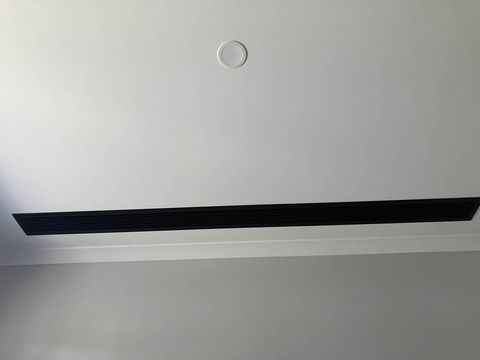
A slot diffuser beside a round ceiling fitting
A slot diffuser beside a round ceiling fitting. Oct 2023. A job in Melbourne.
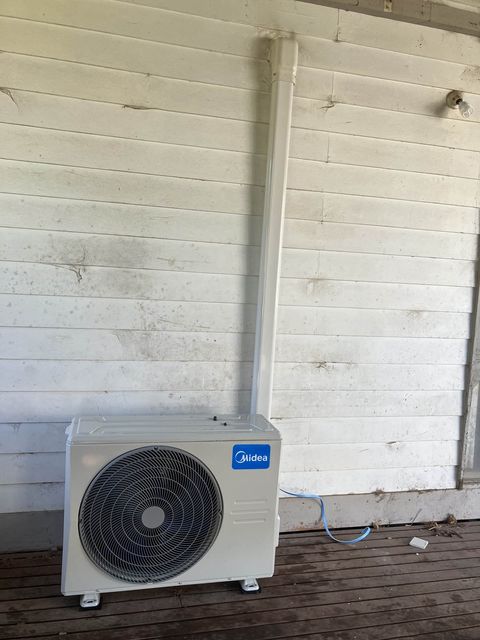
A split system outdoor unit on a timber deck
A split system outdoor unit on a timber deck. Jul 2023. A job in Melbourne.
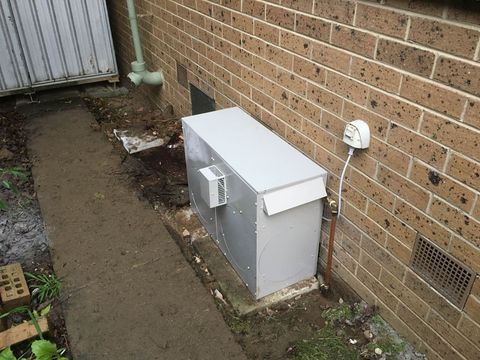
A gas ducted heater with its flue, beside a freshly dug path
A gas ducted heater with its flue, beside a freshly dug path. Sep 2019. A job in Melbourne.

More job photos

Questions people ask

Why does my aircon stop and puff steam on cold mornings?
It's probably defrosting. Mitsubishi Electric says frost builds on the outdoor unit when it's cold and humid, and heating pauses for up to 10 minutes while it clears. The white vapour comes from the defrost, not smoke.
One head of my multi-split won't run. Is it broken?
Check the modes first. Mitsubishi Electric says every indoor unit on one outdoor unit has to share a mode, so a head set to cooling while another is heating will sit idle.
Can you get someone to look at it?
Licence-checked repair specialists on the Central Coast see your job, where we have them, and the one who takes it contacts you to arrange a time. No other installer gets your details. If no Central Coast specialist takes it within 48 hours, repairers elsewhere in NSW may see it too.

Ready for an air conditioning repair specialist to take a look in Central Coast?

Your postcode and three quick questions. Licence-checked local installers who specialise in your kind of job see it, and the one who takes it gets in touch to quote.

Free for you. Installers pay us for each job we pass on.

Other heating and cooling jobs in Central Coast

Suburbs around Central Coast

Where this information comes from

We don't publish prices. Every home is different, so an installer's written quote is the only real number. How we write and check these pages.

Find my aircon