Gladstone facts that shape an install
Cyclone winds
The QRA's guide classes the coast north of Bundaberg, Gladstone included, as Wind Region C, where homes are designed for cyclone winds of 250 km/h. Ask how the outdoor unit and any bracket will be secured to match.
Storm tide and flooding
Gladstone Regional Council has six storm tide evacuation zones. For homes in storm tide prone areas, the QRA recommends relocating electrical wiring, the meter box and other installations above the adopted storm tide level.
Humid, not just hot
Gladstone Radar's mean January maximum is 31.8 degrees, and February afternoons average 65% humidity. Rinnai says an oversized unit short cycles and dehumidifies less effectively, so bigger isn't safer here.
Some apartments
7.1% of occupied dwellings in the council area were flats or apartments at the 2021 Census. For a multi-storey block, The Good Guys requires body corporate approval before any install work, and that's a sensible rule whoever does the job.
Cool nights, briefly
July's mean minimum at the station is 13.9 degrees, so reverse cycle's heat mode is worth having but won't be worked hard.
What makes a Gladstone install bigger or smaller
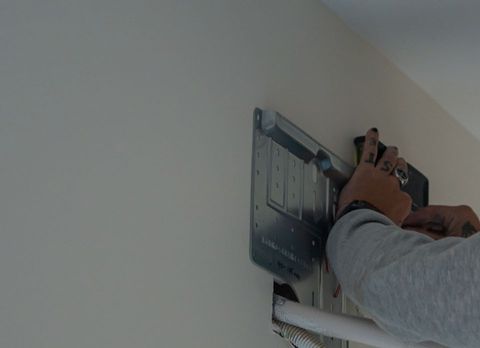
Mounting. A unit on a concrete pad at ground level is the simple job. A wall bracket, a raised stand to clear flood or storm tide level, or a frame on a roof adds hardware, time and a closer look at the fixings.
The pipe run. Back-to-back indoor and outdoor units are quickest. Moving the outdoor unit to a sheltered or higher spot usually means a longer run.
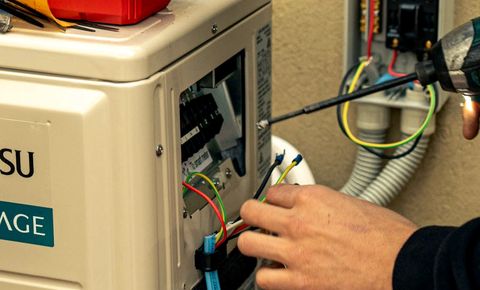
Power. Mitsubishi Electric says each air conditioner needs a dedicated power supply. A full switchboard, or wiring that has to be raised along with the unit, adds electrical work.
Insulation. The Queensland Government's zone 2 advice is to insulate and seal air-conditioned rooms, and ActronAir says a well insulated home likely won't need as much capacity. Our main installation page covers the job step by step.
Corrosion and the brand you choose
Some brands coat their outdoor coils. Carrier says its hi wall outdoor units feature an anti-corrosive coating, and TECO calls its coil treatment Gold Fin Protection. A coating doesn't change the corrosion clause on the warranty card, so read that for the exact model you're quoted.
We're not any brand's dealer. Ask the installer which models they'd fit near the water, and why.
Who can install it
Installation in Queensland needs a QBCC licence for the mechanical services work, at any value, plus an Electrical Safety Office licence for the wiring. The ARC's restricted RSS03 licence covers single-head splits under 18kW; multi-splits and bigger systems need an RAC01 holder.
Where we have them near Gladstone, licence-checked installers who fit that kind of system see your install, and only the one who takes it on gets your phone number and email. If no installer near Gladstone takes it within 48 hours, installers elsewhere in Queensland may see it too. Our Gladstone page covers the local climate in more detail.
Questions for a Gladstone installer
- How will the outdoor unit be fixed down, and what are the bolts and bracket made of?
- Is my block in a storm tide zone, and how high will the unit and isolator sit?
- What size do you recommend, and how did you work it out?
- Does this model have a coil coating, and what does its warranty say about corrosion?
- What's your QBCC licence number, and who's doing the electrical work?
Your homework, and the installer's
You can
- Check the council's storm tide evacuation zones for your address.
- If you're in a unit block, ask the body corporate what approval it needs.
- Ask for the warranty terms of any model you're quoted.
Leave to a licensed installer
- The heat load and size.
- Fixings suited to the job, and the outdoor unit's height.
- Refrigerant pipework, commissioning, and new circuits by a licensed electrician.
What we'd do
Our call for a Gladstone install
We'd ask for a heat load that accounts for humidity, choose the unit that fits rather than the biggest, and have the outdoor unit fixed to a standard the installer can explain. If the address is in a storm tide zone, we'd raise the unit and its isolator above that level from the start, and we'd read the corrosion clause before signing.