What changes an install in Newcastle
Coast or inland
The difference shows in the averages. Nobbys has a 25.7-degree January maximum and a 9.4-degree July minimum, while the university station, 8.5 km inland, has 29.5 and 7.3. An installer sizing a unit in a western suburb should allow for more heat in summer and more heating in winter.
Salt and the outdoor unit
Mitsubishi Electric's instructions list salty places such as the seaside among spots to avoid. Close to the beach, ask which side of the house is most sheltered, and whether the model has a coil coating. Daikin says all its outdoor coils carry its Blue Fin treatment, and that positioning and maintenance still matter.
Shared walls
Semis, terraces, townhouses and apartments make up about three in ten Newcastle homes. Narrow side passages and small courtyards make the outdoor unit harder to place. The ACT Government's guide warns against enclosed courtyards and slat fencing around the unit, because it needs fresh air.
Neighbours
NSW's Protection of the Environment Operations (Noise Control) Regulation 2026 sets restricted hours for air conditioners that can be heard in a neighbour's room. On a tight block, the outdoor unit's position decides whether that ever becomes your problem.
Gas in the street
Jemena supplies natural gas in Newcastle, so some installs replace a gas heater. Under the ESS, a gas space heater installed from 1 July 2026 gets no discount, while a high efficiency air conditioner may.
Which system fits which Newcastle home
For an apartment or a single living area, a split system is the simple answer. Solar Victoria calls them a good fit for single rooms and small units. A terrace with a living room and two or three bedrooms may suit a multi-split, with one outdoor unit in the courtyard instead of several.
In the separate houses that make up 69.0% of the city's homes, ducted is worth having quoted alongside splits. Our Newcastle ducted page covers the zoning and roof space questions.
Licences, paperwork and the ESS in NSW
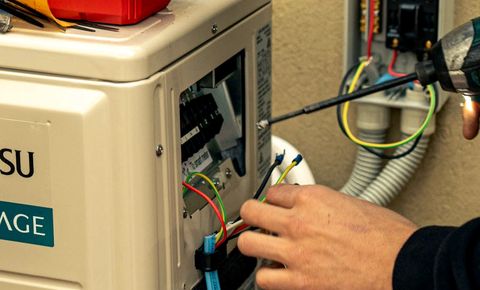
Air conditioning work in NSW needs a licence or certificate, and that includes the wiring that connects the unit. Some licences carry a condition excluding the electrical work, so ask who's doing it. Anyone handling refrigerant also needs an ARC licence: the restricted RSS03 covers single-head splits under 18kW, and anything bigger needs RAC01.
If the installer offers the ESS discount, it should appear on the written quote, and you'll sign a nomination form before installation begins. It's delivered through Accredited Certificate Providers, which work independently of the NSW Government. If someone knocks on your door uninvited to offer it, that job isn't eligible.
Questions for a Newcastle installer
- Have you done a heat load for these rooms, allowing for our westerly days?
- Where will the outdoor unit go, and how is it protected from salt air?
- Does your NSW licence cover the electrical connection, or is an electrician coming too?
- Do we need strata approval for this, and who arranges it?
- Do you offer the ESS discount, and which Accredited Certificate Provider do you partner with?
- What's your RTA number, and will it be on the quote?
What we'd do
Where we'd start
We'd get a heat load done for the rooms you actually use, by someone who's seen the house, and judge the quote on the outdoor unit's position as much as the model. Close to the beach, we'd pick the most sheltered wall that still breathes. And we'd go with an installer who fits your kind of system every week, whether that's a split in a terrace or ducted in a western suburbs house.