Why splits suit so many Coast homes
Apartments and townhouses
Flats and apartments were 12.8% of occupied homes in the Sunshine Coast council area at the 2021 Census, and townhouses or similar another 13.0%. A split needs no roof space, which is why it suits those homes, and the first question is where the outdoor unit can go.
Humid bedrooms
January afternoon humidity averages 70% at Sunshine Coast Airport. Rinnai says an over-sized system dehumidifies less effectively, so a bigger unit than the room needs can leave a bedroom cold and damp.
Sea air
Daikin's warranty card makes the owner responsible for extra corrosion protection in sea air. If you're close to the water, ask what the brand expects before you choose a model.
Night noise between close neighbours
Queensland's default noise standard says an air conditioner mustn't be more than 3 decibels (A) above background noise at the neighbour's place from 10pm to 7am, or 5 above it during the day, unless the council sets its own. Bedroom units run at night, so that shapes where the outdoor unit goes.
What size split does a Coast room need?
Splits are sold by capacity in kilowatts. Rinnai pitches a 2.5 kW unit at spaces up to roughly 20 square metres and a 3.5 kW unit at up to about 30, but its own guide says ceiling height, insulation and a sun-facing room change the answer.
On the Coast, add humidity to that list and resist going up a size just to be safe. Our size calculator gives you a starting point before anyone visits.
How a split goes in
Pick the outdoor unit's spot first
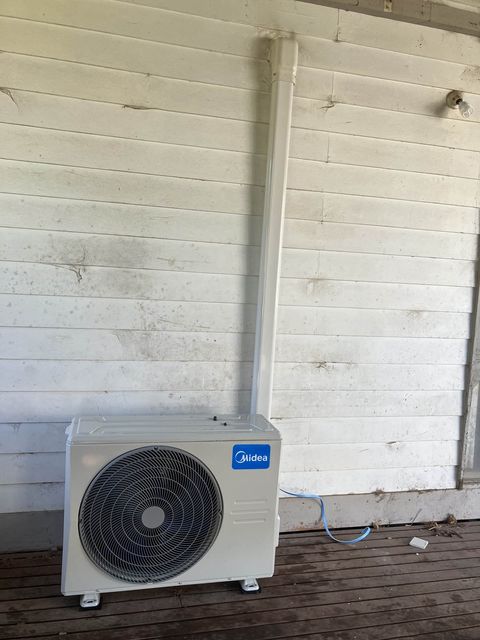
Sheltered from the sea, open to fresh air, reachable for servicing and away from a neighbour's bedroom window. The ACT Government's guide warns against enclosed courtyards and boxing the unit in with slat fencing.
Power and drain
Mitsubishi Electric says the unit needs a dedicated power supply. The condensate drain (the small pipe carrying water away) needs a steady fall, because a split here pulls a lot of water from the air in summer.
Seal and test
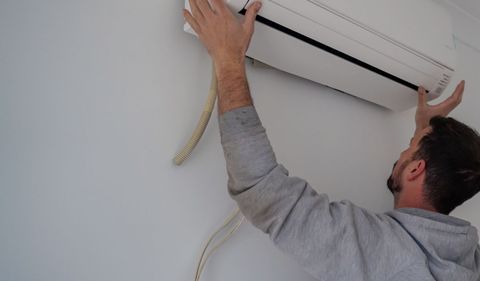
The wall hole is sealed so storm rain can't follow the pipes in, then the system is run in cooling and heating before handover.
Which licence does a split installer need?
For a single-head split under 18kW, the technician can hold the restricted ARC licence, RSS03. A multi-head system, a bigger unit, or any later repair or regas that touches the refrigerant needs a full RAC01.
On top of that, Queensland needs a QBCC licence for the mechanical services work at any value, and an electrical licence for the new circuit and the cable between the units. Our split system page covers the install in more depth.
Your part, and the installer's
You can
- Pick the rooms you actually use in the afternoon and at night.
- In a unit or townhouse complex, check with the body corporate before you book.
- Look at where the outdoor unit could go, and who sleeps on the other side of that fence.
- Once it's in, clean the filters as the manual says.
Leave to a licensed installer
- The heat load and the final size.
- Refrigerant pipework, pressure testing and commissioning.
- The new circuit and interconnect cable, by a licensed electrician.
- Sealing the wall and setting the drain.
Questions to ask about a Coast split
- What capacity would you fit in this room, and why that size?
- Where would the outdoor unit go, and how close is that to the neighbours' bedrooms?
- What does this brand's warranty say about salt air?
- Which ARC licence do you hold, and can you come back to service it later?
- Is the new circuit included, and who's doing it?
What we'd do
If it were our bedroom
We'd choose where the outdoor unit goes before choosing the model, making sure it's out of the sea air and not under the neighbours' window, then size the unit from the room rather than the biggest special in the shop. A split specialist will set the drain fall and the wall seal properly, which matters in a humid, stormy summer. Tell us the room and your postcode. Where we have them, licence-checked installers who fit splits all the time will see it, and your contact details go to the one who takes it.