Why Perth houses suit ducted, and what to check
Mostly separate houses
At the 2021 Census, 77.8% of Greater Perth's occupied dwellings were separate houses. A single-storey house with a usable roof space is about the simplest ducted job there is.
Older brick and tile
The City of Cockburn's heritage guide describes Ranch houses from 1945 to 1980 in brick, or brick and timber, with tiled roofs and extended eaves, and inter-war bungalows mostly in brick. In homes like these, ask the installer to check roof access, ceiling insulation and where the return air grille can go before they quote.
Hot afternoons
Perth averages 26 days above 35 degrees. ActronAir says a system loses cooling capacity above 35, giving the example of a 14kW unit dropping to 10 or 12kW, so one sized with no margin falls behind on the days you need it most.
Inland heat
January averages 33.6 degrees at Pearce and 33.0 at Gosnells, against 29.8 at Swanbourne. Two identical houses in those places shouldn't get identical quotes.
Switching from ducted evaporative to ducted reverse cycle
Ducted evaporative was the most common cooling in WA homes in the ABS's 2006 survey, at 32%, so plenty of Perth houses already have a roof unit, ducts and ceiling outlets. Moving to ducted reverse cycle gets you heating, and lets you close the house up, which Seeley says is how reverse cycle is designed to run.
Don't assume the old ducts or outlets can stay. Ask the installer to put in writing what's reused, what's new, and how the old roof unit's opening will be closed and made watertight. Coming off gas ducted heating instead? The ACT Government guide says those ducts are too narrow for reverse cycle, so expect new ducting throughout.
Zoning a Perth house
Zoning splits the house into areas you cool or heat separately. ActronAir says it works through dampers in the ductwork that open and close, and Daikin's example puts bedrooms in one zone and living areas in another.
In Perth that might mean living areas running through the afternoon and bedrooms at night. ActronAir notes a system can only heat or cool at one time, with no more than a 4-degree spread between zones, so a west-facing lounge and a shady bedroom still share one setting range.
What makes a Perth ducted job bigger or smaller?
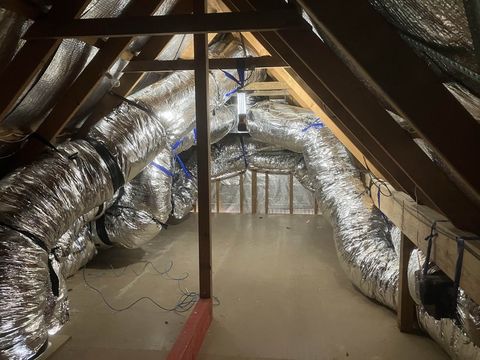
Two storeys, a low roof pitch or a cramped ceiling space all make duct runs harder. More zones, a long run to the outdoor unit and lifting an old cooler off the roof add time too.
The ACT Government guide says a large house may need a 3-phase power upgrade for ducted, and recommends at least R1.5 insulation on the ducts, which suppliers may not include unless you ask. In WA, any new circuit or switchboard work is for a licensed electrical contractor. Our main ducted air conditioning page covers the install step by step.
Questions to ask a Perth ducted installer
- Can I see the heat load for each room, and how much capacity the system keeps above 35 degrees?
- What insulation rating are the ducts, and is it R1.5 or better?
- How will you zone it, and does each zone have its own temperature sensor?
- What are you reusing from the old system, and how will you seal the old roof opening?
- Who's the electrical contractor, and what's their EC number?
- Does the brand's warranty require yearly servicing?
Your part, and the installer's
You can
- List which rooms you use in the afternoon and which at night.
- Note any room that's always hotter, like a lounge with big west windows.
- Once it's running, clean the return air filter the way the manual shows.
Leave to a licensed installer
- Everything in the roof space. WorkSafe Victoria reports workers falling through plaster ceilings, so it's no place to explore.
- Duct design, sizing and zone dampers.
- Refrigerant work, commissioning and the electrical connection.
What we'd do
If it were our home
We'd ask for a room-by-room heat load that allows for the 35-degree days, R1.5 or better on the ducts, and at least two zones, living areas and bedrooms. If an old evaporative unit was coming off the roof, we'd want the reuse and the roof repair spelled out on the quote. And we'd give the job to a ducted specialist, because the duct design decides how well the whole system works.