Which system suits a Brisbane home?
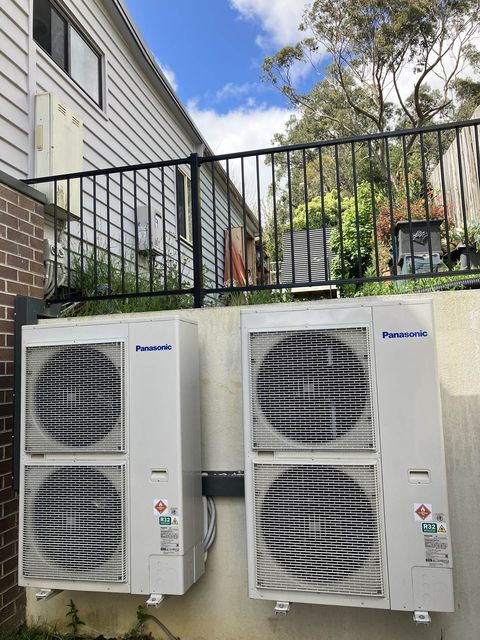
Choose by the rooms you actually use. One bedroom or living area suits a split, a multi-split runs a few rooms from one outdoor unit, and ducted suits a larger house where you want every room done. Our page on split systems in Brisbane goes deeper on single rooms.
Whichever you pick, make it reverse cycle. For climate zone 2 homes like Brisbane's, the Queensland Government's design aim is cool interiors in summer with some warmth for winter, and a reverse cycle system handles both.
What changes an install in Brisbane
Humidity changes the size
Rinnai says an oversized system short cycles and dehumidifies less effectively. With summer dew points around 20 degrees, a unit that's too big chills the room fast and leaves it clammy.
Brisbane sits in the label's hot zone
The example energy rating label in the ACT Government's guide groups Brisbane with Darwin as hot. Comparing models, read the blue cooling stars for the hot zone first.
High ceilings and timber walls
ActronAir's rough sizing rule allows 150 watts per square metre under a 2.4m ceiling and 175 watts under a 3m one, and warns it ignores plenty. A Queenslander's tall rooms are one reason a proper heat load beats a guess.
Not the retail standard house
Appliances Online builds its standard install around a single-storey brick veneer home with a tile roof. Until recently most Brisbane homes were built of timber, so expect a quote that deals with your walls, roof and stumps.
Flood-prone streets
The 2022 flood reached properties in all but 11 of Brisbane's 188 suburbs. Get Ready Queensland suggests raising air conditioner units and switchboards above the flood level, so ask where the outdoor unit will sit if your street has flooded.
The west wants heating too
Amberley, near Ipswich, averages a July low of 5.1 degrees. Out that way, check the heating capacity on the label as carefully as the cooling.
The licences a Queensland install needs
Queensland requires a QBCC licence for mechanical services work, which includes installing air conditioning, at any job value. The refrigerant side needs an ARC licence too: RSS03 covers single-head splits under 18kW, and anything bigger or with several heads needs RAC01.
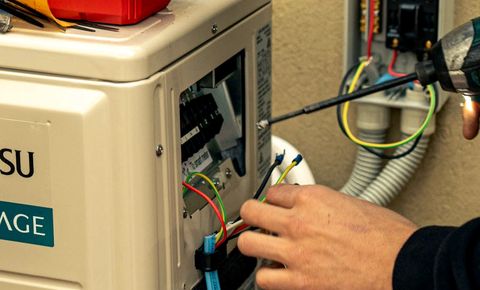
The wiring is its own trade. QBCC says a restricted electrical licence for air conditioning doesn't allow electrical installation work, such as running the interconnect cable between the two units, and a refrigerant licence on its own allows no electrical work at all. Ask who does the electrical part, and check their Electrical Safety Office licence.
Questions for a Brisbane installer
- Did you work out a heat load for each room, including ceiling height and west-facing glass?
- Is this size right for taking moisture out, not just for cooling fast?
- Where will the outdoor unit go, and is that above the flood level here?
- Who does the electrical work, and what licence do they hold?
- What's your QBCC licence number, and what's your RTA number?
What you can sort out first, and what's the installer's
You can
- Note which rooms you use through a Brisbane summer, and at what times.
- Find out whether your street flooded in 2022 before the site visit.
- Photograph the switchboard and the walls where you'd like the units.
- Look the installer up on the QBCC register before you sign.
Leave to a licensed installer
- The heat load and the final size.
- Refrigerant pipework, pressure testing and commissioning.
- New circuits and any switchboard work, done by a licensed electrician.
- Brackets, frames or raised stands for the outdoor unit.
What we'd do
If it were our home
We'd ask for a heat load on every room and push back on anything that looks oversized, because comfort in Brisbane is as much about dry air as cold air. We'd keep the outdoor unit above any past flood line, and out of a closed-in under-house space where it can't breathe. And we wouldn't sign at the kitchen table. Asking for a quote doesn't make that deal invited, so it may still have a 10 business day cooling-off period.